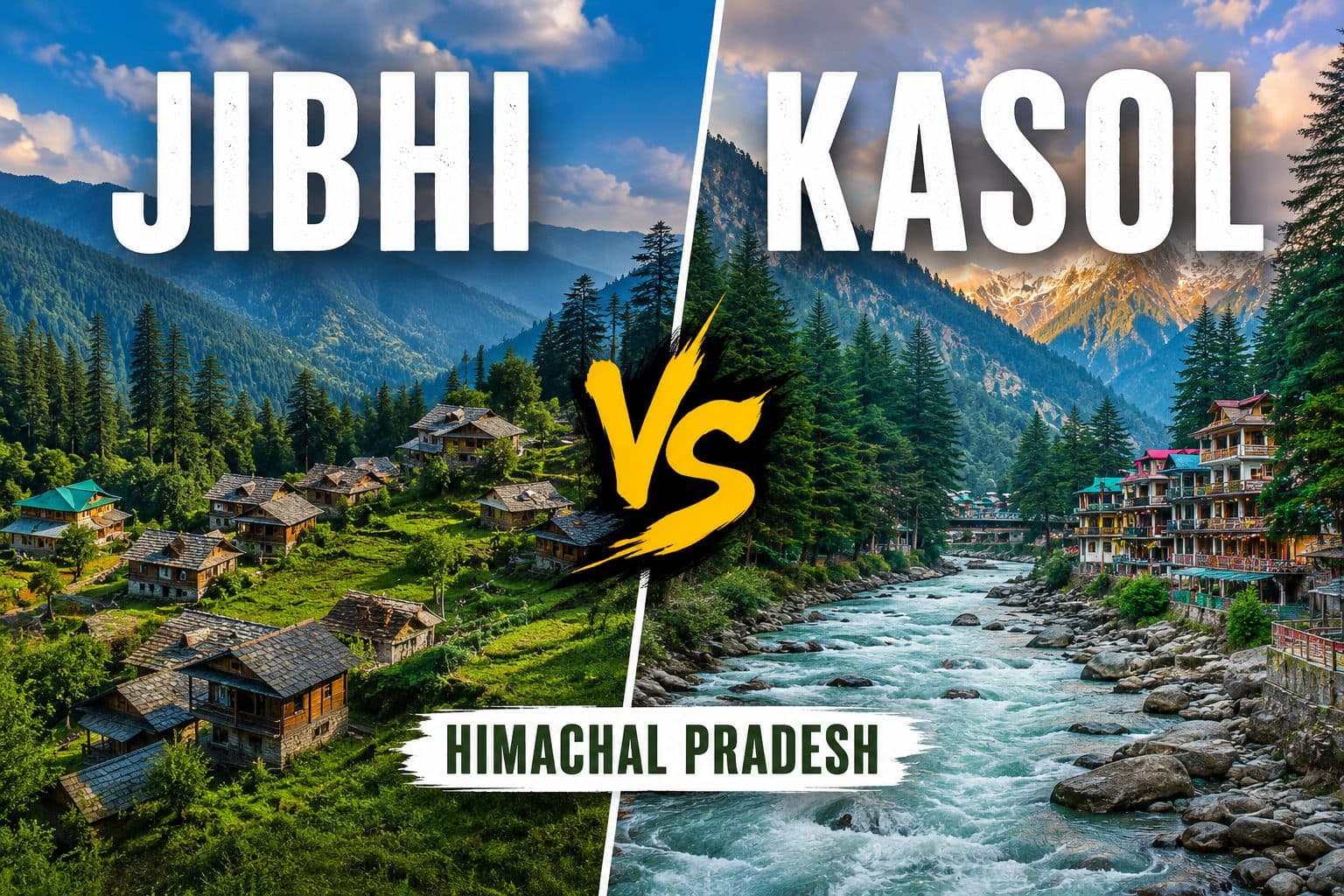
Manali has been Himachal Pradesh's biggest name for decades. Ask any Delhi family where they went for their first mountain holiday — nine times out of ten, the answer is Manali. It's the default. The safe choice. The one everyone already knows. Jibhi is different. It doesn't have a Mall Road. It doesn't have a cable car or a ski resort or a nightclub on every corner. What it has is the Tirthan River, deodar forests that go quiet after 10 PM, wooden cottages built the same way they've been built for five hundred years, and a pace of life that most people from cities have completely forgotten exists. I live here. My family is from this valley. And I get asked this comparison constantly — sometimes by people who've already been to Manali three times. Sometimes by first-timers genuinely trying to figure out which is right for them. So here's my honest answer. No spin, no sales pitch. Just what I actually know.
These Are Not Two Versions of the Same Holiday
This is where most comparison articles get it wrong — they treat Jibhi and Manali as competing options on the same menu. They're not. They're different restaurants serving different food to different people.
Manali is a proper town. It has traffic, hotels with lobbies, ATMs on every street, pharmacies, nightclubs, a cable car, paragliding operators competing for your attention — and the relentless energy of a place that processes millions of tourists a year.
Jibhi is a village that has no interest in being a town. The entire village centre can be walked in twenty minutes. There are no traffic lights. You will hear the river before you see it.
Once you understand that distinction, the rest of this comparison practically writes itself.
Getting Here: The Journey Is Part of the Story
Both destinations pull from the same highway corridor out of Delhi — NH44 through Panipat and Ambala, up through Chandigarh, past Kiratpur Sahib into the foothills, through Mandi, and then onto the mountain roads. From Delhi, you're covering roughly 500 kilometres to Jibhi and about 550 kilometres to Manali. Either way, you're looking at an overnight journey.
Here's where the roads split: Manali travelers stay on NH3 all the way north to the terminal. Jibhi travelers must exit at Aut — a small junction just before the Kullu Dwar tunnel — and take NH305 through Banjar for the final 35 kilometres into the valley.
From Aut, your options:
HRTC local bus to Banjar (under ₹100), then another short bus to Jibhi (around ₹20) — slow but works fine.
Shared taxi from Aut cab point — around ₹500-600 per person, split among passengers
Private cab from Aut — starting from ₹2000-3500 direct to Jibhi / your stay.
The nearest airport is Bhuntar (Kullu-Manali Airport) — about 56 km from Jibhi or a straightforward 50 km run north to Manali. Bhuntar flights are weather-dependent , so road travel remains the more reliable option for both destinations.
The Built Environment: What You're Actually Sleeping In
Manali: New Town vs. Old Town
Manali is really two places that happen to share a name. New Manali is the commercial core — Mall Road, bus stands, dense hotel blocks, parking lots, shops selling identical pashmina shawls. The infrastructure is efficient but the experience is transactional.
Old Manali, about 3 kilometres uphill via Manu Temple Road, is genuinely lovely. Cobblestone lanes, apple orchards, cedar forests, properties built to look like they belong here. This is where the experienced Manali traveler bases themselves. If you're going to Manali, stay in Old Manali — the price difference is small but the experience difference is enormous.
Jibhi: The Forest Is Your Room
There is no "new" and "old" divide in Jibhi. The whole village is built the same way it's always been — Kathkuni stone and deodar timber, no cement, no iron nails, the same ancient construction technique that survived the 1905 Kangra earthquake. Properties are scattered through the forest. Your wooden balcony doesn't face an adjacent hotel — it faces pine trees or the Tirthan stream.
Standard homestays run ₹1,800–3,000 per night, premium treehouses average around ₹4500, and riverside A-frame cabins sit in between. Unlike Manali, prices stay stable year-round — no peak-season inflation surges.
Food: Does Altitude Affect Your Appetite for Variety?
In Manali
Old Manali's cafe scene is genuinely excellent — it's had decades of international backpacker footfall and it shows. You can get shakshuka and hummus pita, Italian pasta, Israeli breakfasts, and continental coffee shop fare. Johnson's Café offers garden seating and live music. The Lazy Dog Lounge is a proper evening spot by the river. Urban Monk in Old Manali does scenic views with a thoughtful menu. The scene runs from early morning until late at night, which matters if you're a night owl.
In Jibhi
Our cafes are smaller, quieter, and in my completely biased opinion, more honest. Nobody here is running a kitchen for 300 covers. Every cafe is owner-operated, the menus are short and seasonal, and the food is built around what the valley actually produces.
The real meals are at homestays — Siddu stuffed with poppy seeds and walnuts, Madra (chickpeas in a slow yogurt gravy), fresh river trout from the Tirthan. For cafes: Emberwood Café for a proper Himachali thali and trout fry. Café Old School for the most beautiful stone-and-wood interior in the valley, plus banana-walnut cake. Forest Bean Café on the cliffside for mushroom olive pizza with a view that makes you forget you ordered food. Tenzin Café for Tibetan thukpa on a cold afternoon.
There is no nightlife here. None. Evening in Jibhi is a bonfire, stargazing, and an acoustic guitar if someone in the hostel common room happens to play. If that sounds like heaven to you, Jibhi is your place. If it sounds like a punishment, Manali has a full nightclub ecosystem — Page 3 Bar, Club Honeymoon Disco on Mall Road, and everything in between.
Adventure: Machines vs. Mountains
Manali: Organised, Accessible, and Mechanised
Manali is the adventure capital of Himachal and it earns that title. Solang Valley (12 km from town) is a purpose-built playground — skiing and snowboarding in winter, paragliding, zorbing and ATV riding in summer. The Solang ropeway lifts you to 3,200 metres in ten minutes without breaking a sweat, which means grandparents and young children can access high-altitude views that would otherwise require real trekking fitness.
The Atal Tunnel provides all-weather access to Sissu in the Lahaul Valley, where you can walk through frozen waterfall landscapes even when the rest of the mountains are impassable. Beas river rafting from Pirdi to Jhidi runs April to June. The economics are accessible: paragliding from ₹500, rafting from ₹2,500 per couple, skiing courses around ₹7,500 for a guided multi-day experience.
Jibhi: Slower, Quieter, and Actually Wild
We don't have a ropeway. We don't have a ski resort. What we have is the Great Himalayan National Park — a UNESCO World Heritage Site — as our backyard, with trails that go into genuine wilderness where the only sound is your footsteps and the occasional distant call of a Himalayan Monal.
The main trekking hub is Jalori Pass (3,120 metres, 13 km from Jibhi by road). From there, the 4-kilometre trail to Serolsar Lake is one of the most beautiful walks in the valley — a sacred alpine lake surrounded by dense oak and cedar. The Raghupur Fort hike is steeper and gives you 360-degree views of the Dhauladhar and Kinnaur ranges from ruins that feel genuinely forgotten.
For the river: trout fishing on the Tirthan is a world-class experience if you're willing to slow down enough to appreciate it. Brown and Rainbow trout, catch-and-release, forest permit required (₹100–200). Seasonal Small-scale paragliding runs around ₹3,499.
Who Should Actually Be Going Where
Go to Manali if:
You're a first-time Himalayan visitor who wants safety nets — pharmacies, hospitals, diverse restaurants, and reliable ATMs within walking distance
You have young children or elderly family who need accessible infrastructure
You want snow activities, a cable car, and mechanised adventure sports
You're a digital nomad needing reliable Jio Fiber or Airtel Broadband — Manali has co-working spaces and monthly rentals from ₹10,000–25,000
You want nightlife, live music, and late evenings on Mall Road
Come to Jibhi if:
You're a couple — honeymooners especially. Research from regional travel planners shows roughly 7 out of 10 couples now choose Jibhi over Manali when properly consulted, and report zero regret
You're burned out and need genuine rest rather than a change of scenery to stare at your phone in
You want to eat real Himachali food cooked by someone who grew up making it
You're a solo traveler, writer, or creative who works best in silence
You want to trek into protected wilderness rather than ride a cable car to a vantage point
WiFi caveat: if you need sustained video calls or large file uploads, Jibhi's network (BSNL and Jio, Airtel) is weather-dependent. Plan asynchronous work, not live meetings.
Seasonality: When to Come
Spring and early summer (March to June) is the main season for both. Manali's orchards bloom and Solang Valley hums. Jibhi is green and lush, and Jalori Pass is open — the best time for Serolsar Lake and GHNP treks.
Monsoon (July to August) is risky for both — landslides, highway closures, swollen rivers. Avoid unless you have flexibility and a good attitude about changed plans.
Autumn (September to November) is my personal favourite in Jibhi. The crowds thin out, skies go crystal clear, foliage turns amber and gold, and the light through the deodar forest in late October is something I find genuinely hard to describe. Manali is also beautiful in October — and the Kullu Dussehra festival (begins Vijaya Dashami) is one of the most remarkable cultural events in Himachal, with hundreds of deity palanquins converging in Dhalpur Maidan. If you're in the corridor during this period, experience it — but expect heavy valley traffic.
Winter (December to February) divides the two destinations sharply. Manali thrives — Solang and Sissu fill up with snow tourists, the Winter Carnival runs in early January. Jibhi becomes a frozen, silent retreat with Jalori Pass closed — but for the traveler who actively wants a cabin in the woods with a bukhari, thick blankets, and stars clearer than anything they've seen, Jibhi in winter is extraordinary.
One Valley or Both? The 7-Day Circuit
If you have time, you don't have to choose. A natural circuit works beautifully:
Days 1–3 in Manali: Base in Old Manali. Solang Valley on Day 2, Atal Tunnel to Sissu on Day 3. Experience the snow and the energy. Eat well, stay up late if that's your thing.
Days 4–7 in Jibhi: Drive south on NH3 to Aut, then NH305 into the Banjar Valley. Four nights. Jalori Pass and Serolsar Lake when open. Tirthan riverside and GHNP trails. Chehni Kothi for the architecture. Let the valley do what it does.
Planning a longer circuit? Jibhi is almost perfect starting point for Jibhi-kasol-manali trip. Three days in jibhi ,one night in Kasol , tthree nights in Manali, — and you've covered three completely different Himachal moods in a single week. Forest quiet, Parvati Valley soul and Mountain energy.
The Bottom Line
Manali is a mountain town that has been perfected for tourism. It is efficient, comprehensive, and genuinely capable of delivering a very good holiday to almost anyone. It deserves its reputation.
Jibhi is something different. It is not trying to compete with Manali. It's not trying to be anything except what the Banjar and Tirthan valleys have always been — quiet, old, and deeply themselves.
The choice tells you something about what you actually need from a holiday rather than what you think you should want. If you need to be kept busy, Manali keeps you busy. If you need to stop — really stop, the kind of stopping that takes a day to settle into — Jibhi does that in a way I've never seen any other destination manage.
I've watched guests arrive here exhausted and leave transformed. I've watched couples find each other again in this forest. I've watched solo travelers sit by the Tirthan for entire afternoons and come back to the property looking lighter than they did when they left.
FAQs — Jibhi vs Manali
Q: How far is Jibhi from Manali?
A: Jibhi is roughly 100–110 km from Manali by road, and the drive takes about 3 to 4 hours depending on Kullu traffic and the weather. The route is pretty straightforward — you head south on NH3 from Manali, cross the Aut Tunnel, and then turn onto NH305 into the Banjar/Tirthan Valley.
Q: Which is better, Jibhi or Manali?
A: Honestly, it depends on the kind of trip you want. Manali is louder and more commercial, packed with the usual adventure stuff like Solang Valley, Rohtang, and Old Manali cafes — great if you want activity and a buzzing town vibe. Jibhi is the opposite — quiet forests, wooden homestays, slow mornings by the Tirthan river. For couples, families, first-timers, and anyone who wants to actually unwind, Jibhi wins. For a high-energy holiday with skiing, paragliding, and crowds, Manali is the better fit.
Q: What is the nearest airport to Jibhi and Manali?
A: Both share the same nearest airport — Bhuntar, also called Kullu-Manali Airport. It's around 50 km from Manali and roughly the same distance from Jibhi, about a 2-hour drive either way. Flight options into Bhuntar are limited and on the pricier side, so most travelers fly into Chandigarh or Delhi and drive up from there.
Q: How far is Tirthan Valley from Manali? A:
Tirthan Valley is around 100 km from Manali and takes about 3 to 3.5 hours by road via Kullu and Aut. Jibhi sits in the same belt — Jibhi and Tirthan Valley are practically neighbours, just a short drive apart, so most travelers stay in one and explore the other without any extra planning.
Q: How far is Shoja from Manali?
A: Shoja is around 105–110 km from Manali, roughly a 4-hour drive. It sits just above Jibhi on the way up to Jalori Pass, so if you're already in Jibhi, Shoja is only 7km and 30-40 minute drive higher up. A lot of travelers use Jibhi as their base and do Shoja and Jalori Pass as a day trip, especially in winter when the upper slopes get snow.
Q: Is there a direct bus from Manali to Jibhi?
A: There isn't a steady all-day direct HRTC or Private bus from Manali to Jibhi, but the workaround is easy. You hop on any Manali–Kullu or bus and get off at Kullu Terminal.From kullu local buses and shared cabs run to Jibhi through the day. The whole journey usually takes around 3.5 to 4 hours.
Q: What is Manali like in Winter — does Jibhi get the same snow?
A: Manali in Winter is — cold, often snowy, with proper snowfall around Solang Valley and Gulaba. Jibhi sits at a lower altitude, so the village itself stays cold and crisp but doesn't always get heavy snow on the ground. The good part is that the higher spots near Jibhi — Shoja, Jalori Pass, Raghupur Fort — do get solid snowfall in winter. So you get the best of both worlds: a cozy, accessible base in Jibhi and snow play just a short drive up the hill.
Q: Can I visit both Jibhi and Manali in one trip?
A: Absolutely, and plenty of travelers do exactly that. Since they're only 3 to 4 hours apart, clubbing both is easy. A common plan is 2–3 nights in Jibhi for the slow, forest vibe followed by a couple of nights in Manali for the adventure and markets — or the other way around.
Q: Which is better for couples and families — Jibhi or Manali?
A: Jibhi is much better suited for couples, families with kids, and first-time Himachal travelers who want peace and nature without the chaos. The homestays are warm and personal, the roads are quiet, and there's no honking or tourist circus. Manali can feel overwhelming during peak season — long jams near Mall Road, crowded viewpoints, and pushy tour operators everywhere. If your idea of a holiday is chai by the river, forest walks, and a slow pace, Jibhi is the easier yes. If you specifically want skiing, paragliding, or a busier town vibe, Manali still has its charm.