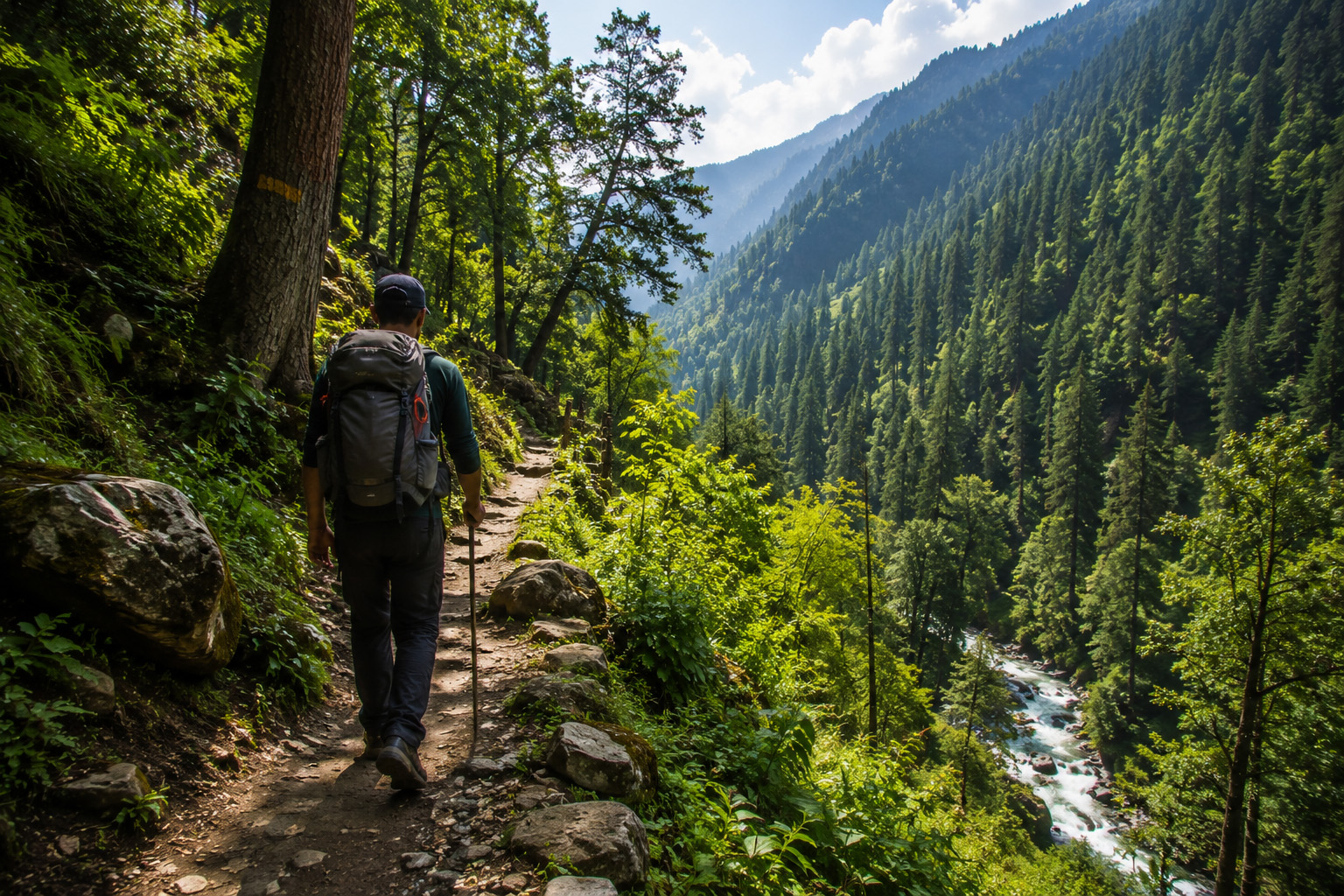
Jibhi · Tirthan Valley · Himachal Pradesh
Things to Do in Jibhi
Treks, Temples, Waterfalls & Local Experiences
Jibhi sits in the kind of valley that gives you more things to do the longer you stay. The obvious moves — the waterfall, a café stop, Jalori Pass — are a good start. But the places that stay with you are usually a little further off the main road.
This page covers everything worth doing in and around Jibhi — distances and difficulty for each, so you can match activities to your pace.
Quick Overview
Nature
Jibhi Waterfall
Nature
Kulhi Katandi
Trek
Jalori Pass
Trek
Jalori Pass → Raghupur Fort
Trek
Jalori Pass → Serolsar Lake
Cultural
Chehni Kothi
Cultural
Balu Nag Temple
Leisurely
Village Walk
Leisurely
Café Hopping in Jibhi
Leisurely
Bonfire Evening
Nature
GHNP Walk
Trek
Chhoie Waterfall Trek
Leisurely
Trout Fishing on the Tirthan
All Activities
Things to Do in Jibhi & Nearby
From easy walks you can do in sandals to full-day treks, from 17th-century temples to an evening around a fire with no particular agenda.
Jibhi Waterfall
1 km from Jibhi market
Usually the first stop after arrival — seasonal and at its strongest in Monsoon . In winter it can slow to a trickle. The path to the base is easy and well-used. Busy on peak-season weekends, quiet on weekday mornings.
Distance
~1.5 km from market
Walk to base
10–15 minutes
Difficulty
Easy
Best season
March–June
Kulhi Katandi
Mini Thailand · 3 km from Jibhi
A clear stream pool tucked into dense forest about 1.5 km from the main market. The water is cold, the shade is dense, and it is quiet in a way that is hard to find near the market. Sometimes called Mini Thailand by travellers — the name fits. Best visited in the morning or late afternoon.
Full guideDistance
~1.5 km from market
Difficulty
Easy
Best time
Morning or late afternoon
Season
March–November
Jalori Pass
~13 km by road · 3,120 m altitude
The single biggest day out from Jibhi. A 45-minute drive up a switchback road brings you to a high mountain pass at 3,120 m with a 360-degree viewpoint and two trek routes heading off in opposite directions. Come for the views, stay for one of the treks — Raghupur Fort (shorter, steeper, panoramic ridge) or Serolsar Lake (longer, gentler, ancient deodar forest). The pass has a few dhabas, a small temple, and enough open sky to make the drive worth it even without trekking.
Jacket · Water · Trekking shoes
Road distance
~13 km from Jibhi
Drive time
~45 min
Pass altitude
3,120 m
Best season
April–November
Jalori Pass → Raghupur Fort
From Jalori Pass · Fort at 3,505 m
Trek 3.5 km from the pass to the ridgeline ruins of a watchtower built by the Mandi rulers to monitor this mountain crossing. The fort structure is modest — the view from the ridge is the reason people come. The full Jibhi valley below, Tirthan and Kullu ranges in both directions, the pass road snaking down behind you. Steep in sections. Trail markings are sparse — ask a local at the pass for the starting point.
Jacket · Water · Trekking shoes
From Jalori Pass
Trek only
Trek one way
3.5 km (one way) · 40–60 min
Altitude
~3,505 m
Difficulty
Moderate
Best season
April–November
Jalori Pass → Serolsar Lake
From Jalori Pass · Lake at 3,100 m
The gentler alternative from Jalori Pass. A 4-5 km trail through old-growth deodar and oak ends at a small glacial lake that sits completely still on calm mornings. The Budhi Nagin temple on the lake's bank is active and maintained by local communities. Particularly beautiful in April–May (wildflowers) and October (deodar needles turning gold). The lake is sacred — no swimming or wading.
Water (2L) · Packed lunch · Jacket · Trekking shoes
Road distance
~13 km from Jibhi
Trek one way
4-5 km (one way) · 1.5-2.5 hrs
Altitude
~3,100 m
Difficulty
Easy-Moderate
Best season
April-June, Sep-Nov
Chehni Kothi
~10 km from Jibhi · 17th-century tower
One of the most impressive traditional structures in the entire Kullu district, and one of the least visited. A seven-storey defensive tower in Chehani village built in kath-khuni technique — interlocking wood and stone laid without mortar. The top two storeys were lost in the 1905 earthquake; five storeys remain. It now functions as a temple to Shringa Rishi and Goddess Chehni. A short forest path from Bini village leads to the tower.
Distance
~10 km from Jibhi
Duration
Half day (3-4 hrs)
Difficulty
Easy
Best season
March-November
Balu Nag Temple
Bahu village · 9 km from Jibhi
A kath-khuni shrine in Bahu village — the same interlocking wood-and-stone technique as Chehni Kothi, built centuries ago by local account with no written records. The trail from the road is 30–45 minutes through dense, quiet forest. No stalls, no signage, very few visitors. The temple is actively maintained and locally significant — approach it accordingly. Also searched as 'Balo temple Jibhi'.
Full guideDistance
9 km from Jibhi
Trail to temple
30–45 min from Bahu
Duration
Half day (3–4 hrs)
Difficulty
Easy
Best season
March–November
Village Walk
Jibhi & surrounding hamlets
The older hamlets above and around the main road are a different Jibhi entirely — traditional Himachali homes stacked on slopes, carved deodar doorways, small temples in the middle of lanes, and a pace of life that doesn't make it into travel reels. A 2–3 hour walk takes you past architecture that has been here for centuries alongside more recent construction. No booking needed — just set out from the property toward the village.
Duration
2–3 hours
Difficulty
Easy
Season
Year-round
Café Hopping in Jibhi
Jibhi market · 2.5 km
Most of the good places are in converted wooden houses along the market lane and the stream path — filter coffee, Himachali siddu, freshly made Maggi, and simple seasonal menus. A few have outdoor seating right on the stream bank. None are chains, none have consistent hours, and the best ones change every season. Ask your host the night before which are currently good — local knowledge is more reliable than any list.
Distance
2.5 km from winterfell
Duration
Flexible
Difficulty
None
Season
Year-round
Bonfire Evening
At the property · On request
Jibhi has almost no light pollution. On clear nights the sky above the valley is as good as it gets within a day's drive of Delhi. A bonfire on request at your property — fire, night sky, whatever you bring to it — is one of those evenings that sounds simple on paper and becomes the memory you come home with. No programme, no activities coordinator. Just a fire, the dark, and the sound of the river.
Duration
Evening (flexible)
Difficulty
None
Best season
October-February
GHNP Walk
UNESCO World Heritage Site · Buffer zone
The Tirthan River originates inside the Great Himalayan National Park — a UNESCO World Heritage Site that sits essentially at the valley's doorstep. The buffer zone and river trail near the GHNP gate are accessible with a permit. A guided walk with a certified naturalist covers forest trails along the Tirthan, with 375+ recorded bird species and occasional musk deer and langur sightings.
Location
GHNP buffer zone, Tirthan
Duration
Half or full day
Difficulty
Easy-Moderate
Permit
Required (arrange through stay)
Best season
April-June, Sep-Nov
Chhoie Waterfall Trek
~16 km from Jibhi · Tirthan Valley direction
Less talked about than Jalori Pass but one of the most rewarding half-day treks in the valley. The trailhead is near Nagini village, 16 km from Jibhi in the Tirthan Valley direction. A 3 km forest walk through Himalayan oak, deodar, and blue pine leads to a tall cascade that falls into a cool natural pool at the base — locally worshipped as Chhoie Mata. If you're heading toward Aut on your way out of Jibhi, this fits naturally on the same route.
Trekking shoes · Water
Distance
~16 km from Jibhi
Trek one way
3 km · 45 min–1 hr
Difficulty
Moderate
Best season
March–June, Sep–Nov
Trout Fishing on the Tirthan
Tirthan River · Catch-and-release
The Tirthan runs cold, fast, and undammed — one of the few rivers in Himachal Pradesh where the current is still fully natural. It holds both brown and rainbow trout. A local guide who knows the named pools (Khundan Bridge, Deori Pools, the GHNP gate stretches) makes the difference between a hopeful morning and an actual catch. No prior experience needed — it is as much about sitting beside the river as anything else.
Season
March 1 – October 31
Permit
₹300/day (arranged through stay)
Duration
3–5 hours
Difficulty
Easy
Itinerary Guide
How to Plan Your Days in Jibhi
The valley rewards longer stays. Here is a tested day-by-day breakdown for how to spread activities without rushing.
2 Days
Arrive, settle in. Afternoon: Jibhi Waterfall + Kulhi Katandi. Evening café in the market.
Full day at Jalori Pass — choose Raghupur Fort or Serolsar Lake. Bonfire evening at the property.
3 Days
RecommendedArrive. Jibhi Waterfall + Kulhi Katandi. Village walk in late afternoon.
Full day at Jalori Pass — Raghupur Fort or Serolsar Lake.
Chehni Kothi or Balu Nag Temple in the morning. Trout fishing or café afternoon. Depart or overnight.
4+ Days
Follow the 3-day plan above.
Chhoie Waterfall Trek (Tirthan Valley). Easy half-day drive.
GHNP guided walk. Both Jalori Pass treks if you only did one. Late checkout, slow final morning.
Frequently Asked
FAQ: Things to Do in Jibhi
What are the best things to do in Jibhi for first-time visitors?
Start with the Jibhi Waterfall and Kulhi Katandi — both are easy, close, and give you a feel for the valley. Then do a full day at Jalori Pass with either Raghupur Fort (better views, shorter walk) or Serolsar Lake (forest, sacred lake, more peaceful). Those three experiences cover the best of Jibhi for most visitors.
What is there to do in Jibhi in winter?
More than most people expect. The Jibhi Waterfall, village walks, café hopping, and Balu Nag Temple all work year-round. Jalori Pass road can close in heavy snowfall (December–February), but when accessible the snow-covered forest and 360 Point viewpoint above the pass are exceptional. Bonfire evenings are at their best in winter.
Are there easy things to do in Jibhi without trekking?
Yes. The Jibhi Waterfall and Kulhi Katandi require only a short walk on mostly flat ground. Village walking, café hopping, and an evening bonfire require no trekking at all. Trout fishing is also easy — you're sitting beside the river. Chehni Kothi (short forest path) and Balu Nag Temple (30-minute forest walk) are both accessible for most fitness levels.
What are the best places to visit near Jibhi?
Within 20 km: Jalori Pass (treks, 360 Point viewpoint), Bahu village (Balu Nag Temple), Bini village (Chehni Kothi). Within 30 km: Tirthan Valley and GHNP gate, Sojha village with wider mountain views.
What is the best time to visit Jibhi for outdoor activities?
April–June and September–November. April and May open the season with fresh greenery and wildflowers. October is the single best month — clear post-monsoon air, autumn foliage, all trails accessible, fewer visitors than summer. If you're flexible, October–early November is the strongest window for most activities.
What is there to do in Jibhi for couples?
Village walks, café hopping, and the waterfall visit work well without much planning. A full day at Jalori Pass — choose the gentler Serolsar Lake trail — is one of the better couple experiences. Trout fishing by the river is another quiet option. A bonfire evening at your stay rounds out any day.
Plan Your Trip
Want to Combine Experiences?
Tell us how long you're staying and what kind of trip you want — active, slow, cultural, or a mix — and we'll put together a day-by-day plan. We can also arrange transport to Jalori Pass, GHNP, and Tirthan Valley the evening before so there's no scrambling on trek mornings.
Replies within 15 mins · 9am – 9pm daily