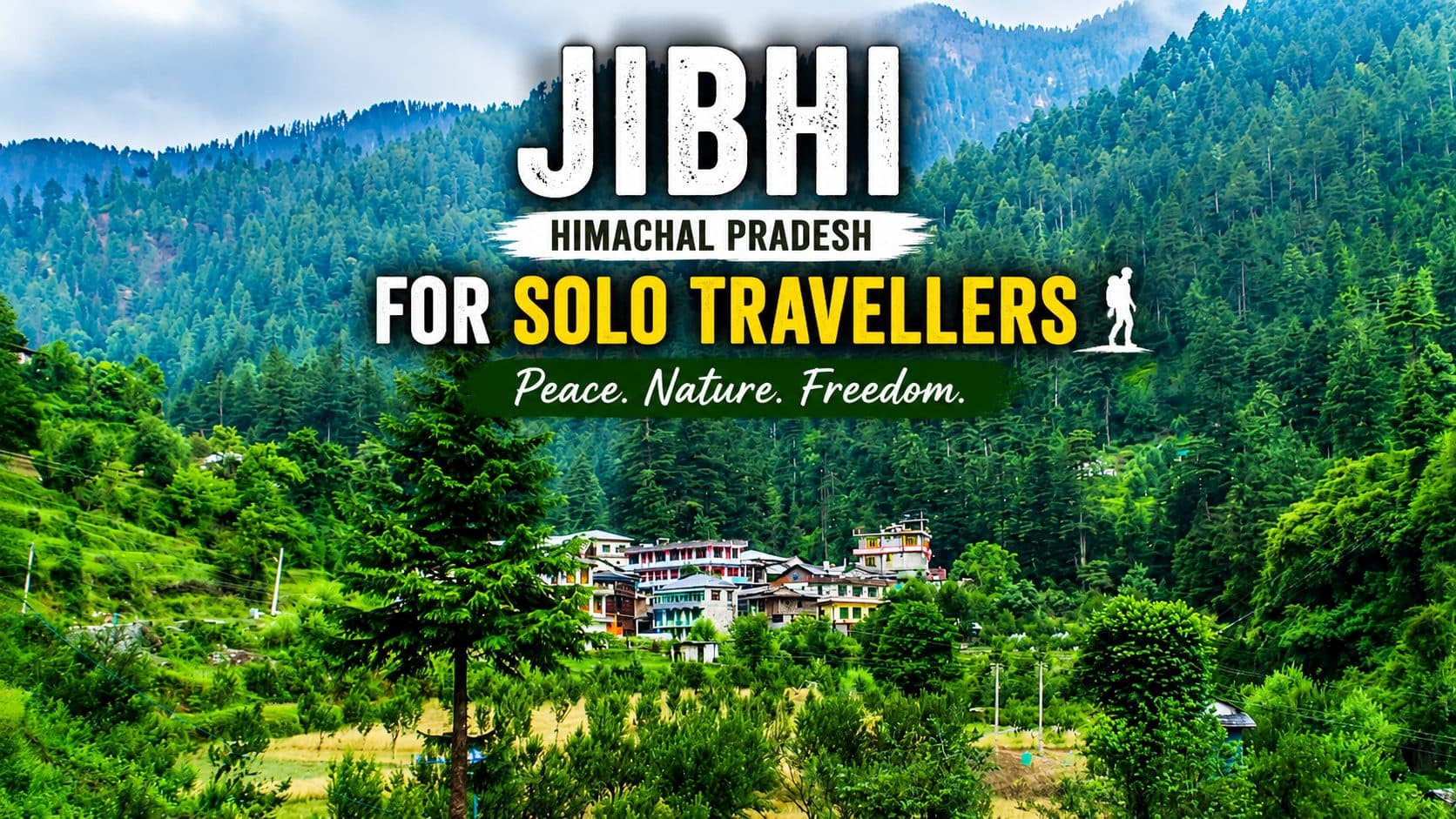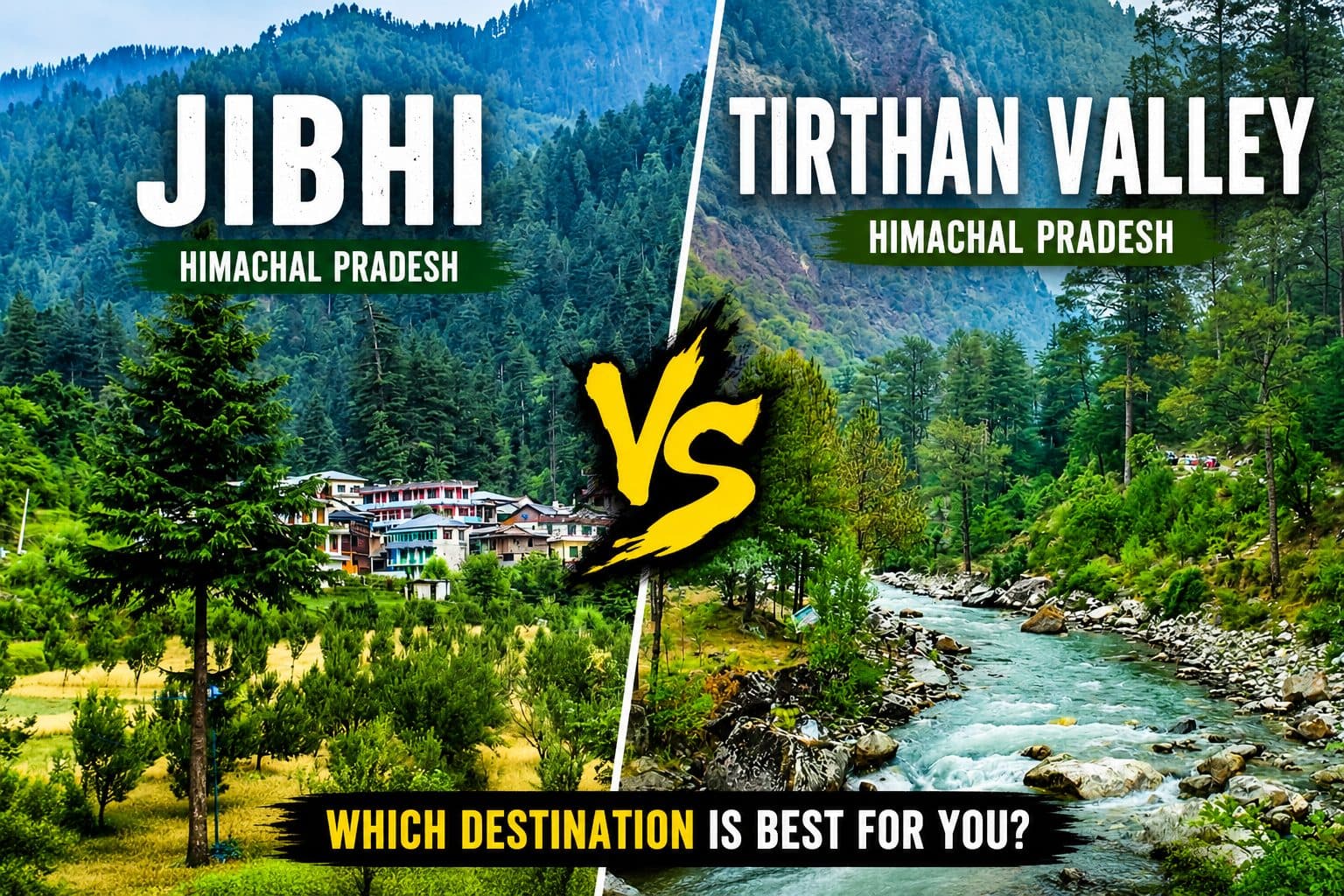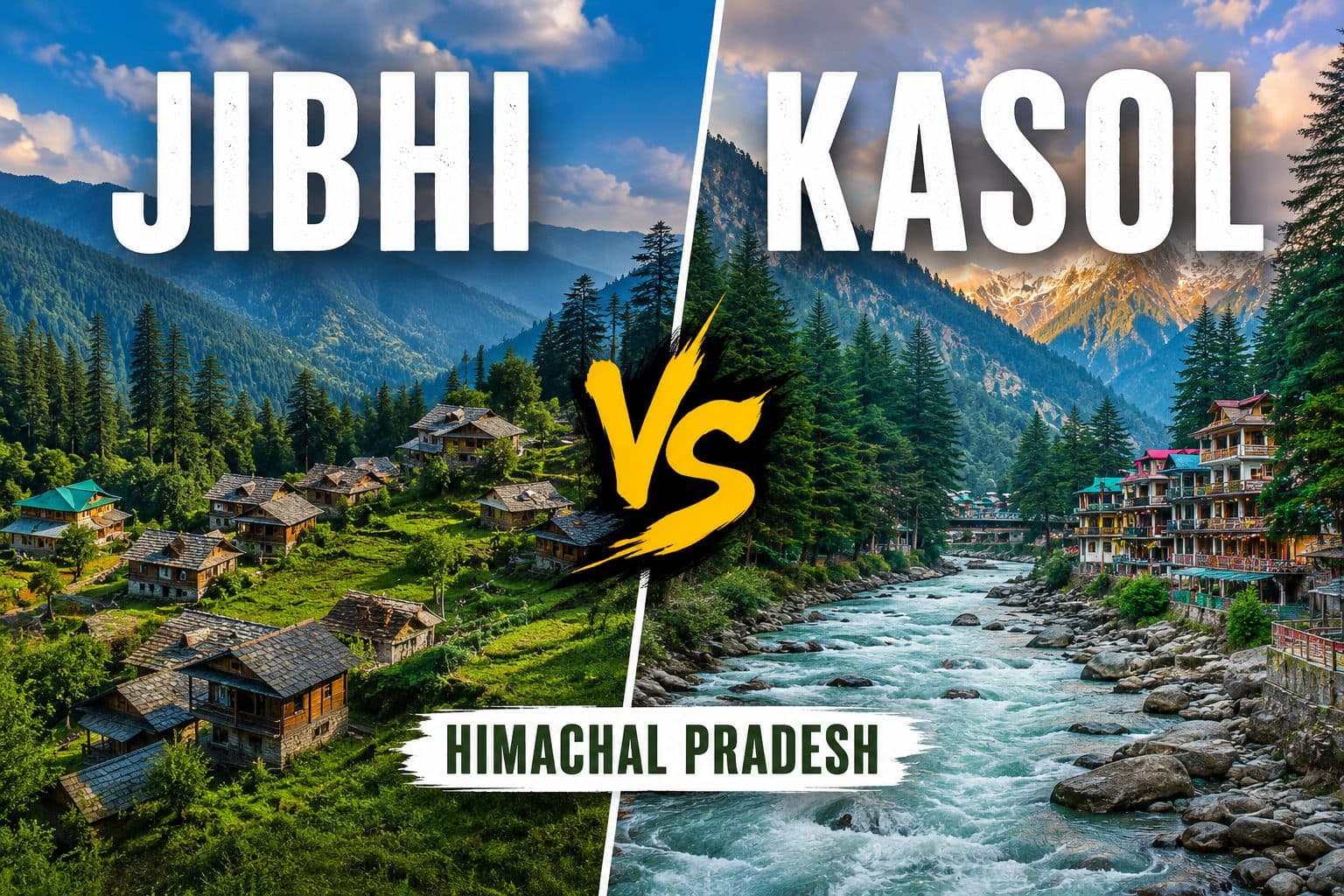
Every week, someone messages us asking the same question: "Should I go to Jibhi or Kasol?" And honestly? I love this question. Because I've grown up watching this valley — the Banjar Valley, the Tirthan Valley — quietly become one of Himachal's most beloved destinations while Kasol was already famous. I've watched travelers arrive expecting one thing and leave having experienced something they can't quite put into words. So let me give you an honest, ground-up answer. Not the kind you read on a travel aggregator written by someone who visited for three days. This is from someone who lives here, who wakes up to the sound of the Tirthan River every morning, and who genuinely wants you to make the right choice for your trip.
First Things First: These Are Two Very Different Places
This is the most important thing to understand before comparing anything else. Jibhi and Kasol are not two versions of the same experience. They are fundamentally different kinds of destinations — and the right choice depends entirely on what you're actually looking for.
Kasol is energy. It's the buzz of a crowded cafe at 11 PM, Hebrew menus, trekkers planning expeditions over wood-fired pizza, backpackers from all over the world trading stories. It's loud, it's social, it's exciting.
Jibhi is stillness. It's waking up in a wooden cottage surrounded by deodar forest and realizing you've forgotten to check your phone. It's the kind of quiet that takes a day to settle into — and once it does, you don't want to leave.
Neither is better. They're just built for different people.
Getting Here: What the Journey Actually Looks Like
Both destinations pull from the same main artery — the Chandigarh-Manali highway — but they split at a critical point.
If you're coming from Delhi, you're looking at roughly 500 kilometres and a 12 to 13-hour drive, typically overnight. Most people take a Volvo bus from Delhi or Chandigarh. The nearest airport for both destinations is the Kullu-Manali Airport at Bhuntar — about 60–70 km from Jibhi and 31 km from Kasol.
Here's where the roads diverge: travelers heading to Jibhi exit at the Aut Tunnel and take NH305 through Larji and Banjar — about 30 kilometres of winding mountain road. Kasol travelers continue past Aut to Bhuntar, then head 30–32 kilometres east into the Parvati Valley along the river.
The Soul of Each Place: Culture and History
Kasol: Where the World Converged in the Parvati Valley
The Parvati Valley has a mythology older than tourism itself. Local legend says Lord Shiva meditated in these mountains for 3,000 years before opening his eyes and naming the valley after his consort Parvati. That ancient spiritual weight still hangs in the air.What makes Kasol globally famous is something more recent and sociologically fascinating: its identity as "Mini Israel of India." Starting several decades ago, young Israelis completing mandatory military service began settling in the Parvati Valley in large numbers — seeking peace, affordable living, and mountain solitude. This happened organically, before formal India-Israel diplomatic relations even existed. The result was a complete transformation of the local economy: Hebrew signboards, Israeli cafes, a Chabad house that became a cultural anchor for the community.
Deeper into the Parvati Valley lies Malana — an anthropological anomaly. The Malanese claim descent from Alexander the Great's soldiers, maintain their own language (Kanashi), their own ancient parliament, and enforce strict "no-touch" rules for outsiders. Violations carry financial penalties used for purification rituals. It's fascinating, complex, and unlike anywhere else in Himachal.
Jibhi: The Valley That Chose to Stay Itself
We still build in Kathkuni style here — alternating layers of locally sourced deodar wood and stone, fitted without cement, mortar, or iron nails. This ancient technique creates buildings that are structurally massive and seismically flexible — designed by our ancestors to survive earthquake-prone terrain. The proof stands 14 kilometres from Jibhi at Chehni Kothi: a tower over 1,500 years old, over 45 metres tall, that survived the devastating 1905 Kangra earthquake and still stands.
The Shringa Rishi Temple in Baggi village is the spiritual centre of our valley — dedicated to the sage who performed the ritual that led to Lord Rama's birth in the Ramayana. It's not a tourist attraction. It's the living heart of this community.
Our calendar still revolves around agrarian festivals: the Faguli Festival with deity processions and trance dances, and the Sair Festival in September marking harvest's end with the ceremonial galgal fruit procession and communal feasts of Siddu and Chha Gosht. These happen whether visitors are watching or not.
Where You'll Stay
Kasol
Kasol is designed for volume and social interaction. Zostel, The Hosteller, Alt Life — major hostel brands operate full facilities with dorm beds from ₹500–800 per night. Budget riverside cottages along the Parvati start around ₹600. The entire infrastructure is optimized for solo travelers who want to meet people immediately and not feel alone.
Jibhi
We do things differently here. No massive concrete structures or 50-bed dormitories. Accommodation is deliberately dispersed — private wooden cottages in pine forests, boutique homestays in apple orchards, and treehouses that give you the absurd luxury of waking up in the canopy with a valley view stretching to the Dhauladhar range.
At Winterfell Jibhi, we operate across two sites in Jibhi and Tandi with properties designed to give you the forest cottage experience alongside thoughtful, personal hospitality — from people who genuinely love this valley.
When you stay in a local homestay, you're eating meals cooked from garden produce, sitting by a fireplace while your host tells you about the forest, adapting to a pace that feels foreign for the first few hours and then exactly right. Most homestays observe quiet after 10 PM. That's not a rule — that's just how the valley breathes.
Food: Global Menus vs. The Real Himachal
Kasol
The cafes are genuinely excellent. Moon Dance Cafe, ATS- Kasol (Riverside Cafe & Stay), Jim Morrison Cafe — these places have achieved cult status. You can get authentic falafel, shakshuka, schnitzel, wood-fired pizza, and espresso in the middle of the Himalayas. The Gurudwara Manikaran Sahib serves free langar — nutritious communal meals open to everyone regardless of faith.
Jibhi
Our food is quieter and more honest. The best meal you will eat in Jibhi will almost certainly be in a homestay kitchen. Siddu — dense steamed bread stuffed with poppy seeds, walnuts, and local herbs — served with ghee and local honey. Madra, chickpeas slow-cooked in yogurt gravy. Thukpa when the altitude chill sets in. Fresh river trout from the Tirthan. Foraged lingri (wild Himalayan fern) and wild mushrooms in season.
Commercial cafes exist and they're lovely: Jungle Valley Café near the bridge for thukpa and herbal teas, The Forest Bean Café perched on a cliffside with mushroom olive pizza, Tenzin Cafe for Tibetan food. But they blend into the landscape rather than dominate it. Nobody is trying to feed 400 people. The service is unhurried because nobody here is in a hurry.
Trekking: Which Valley Has Better Trails?
Kasol
Kasol's marquee trek is Kheerganga — a moderate trail through pine forest to a natural hot water spring at about 3,812 metres. Heavily commercialized, with campsites along the route, but popular for a reason. Guided packages run ₹999–1,800 for a full 1-night/2-day itinerary. For experienced mountaineers, the Sar Pass Trek reaches 13,000 feet, and the Pin Parvati crossover is a multi-day wilderness expedition from the Parvati Valley into the cold desert of Spiti — genuinely one of Himachal's hardest treks.
Jibhi
Our trails are gentler and wilder at the same time. Jalori Pass (3,120m, 14 km from Jibhi) is the main high-altitude node. From there, the 5-km walk to sacred Serolsar Lake — surrounded by oak and cedar dedicated to the local deity Budhi Nagin — is breathtaking. The Raghupur Fort hike gives 360-degree views of the Dhauladhar and Kinnaur ranges from ancient ruins.
The real gem is the Great Himalayan National Park (GHNP) — a UNESCO World Heritage Site. Trails from Gushaini go deep into undisturbed wilderness with birdwatching that serious naturalists travel continents for. No vendors. No stalls. Just forest.
For casual visitors, the Jibhi Waterfall is a 1.5-km walk that takes 20 minutes and rewards you properly.
For anglers: the Tirthan River has regulated Brown and Rainbow Trout fishing. A daily permit costs around ₹300. The fishing is slow, meditative, and completely at odds with the frantic pace of modern travel — which is exactly the point.
Who Should Go Where?
Go to Kasol if:
You're a solo young traveler looking to meet people immediately
You want an energetic backpacker scene with international food
You're chasing challenging high-altitude treks like Kheerganga or Sar Pass
Late-night cafe culture is a must for you
Come to Jibhi if:
You're a couple, a family, or a solo traveler who actually wants to be alone with the mountains
You're burned out and need genuine rest — not just a change of location
You care about local culture, architecture, and real Himachali food
You want the Himalayas to feel like the Himalayas — not a hill station bazaar
Solo women travelers: Jibhi is exceptionally safe. The homestay model embeds you in a local family's home and social network.
A Word on Scams (Because Nobody Else Tells You This)
Whether you're heading to Jibhi or Kasol, be aware of two things that nobody puts in the glossy travel guides:
Booking your stay OTAs like Airbnb and Booking.com are fine for discovery — but when you actually book, try to find properties hosted directly by the owner, not an agent managing 15 listings at once. You can usually tell from the profile. Better still, find the property on Google Business Profile and reach out directly. You skip the platform commission, the host gets more, and you often get a better rate or a more personal experience. Win all around.
Booking local taxis Don't flag down random cabs or negotiate with touts near popular spots — you'll overpay and have no recourse if something goes wrong. Ask your host to arrange a cab for you. The drivers they call are people they work with every day — known, trusted, and fairly priced. This especially holds true in Jibhi. The host network here is tight-knit and they genuinely look out for their guests.
The 5-Day Itinerary That Does Both
If you have the time, you don't have to choose. Many travelers do a circuit:
Days 1–2 in Kasol: Arrive, settle into a hostel, cafe-hop, complete a minor trek to Chalal or Grahan, experience the energy.
Days 3–5 in Jibhi: Transit back through Bhuntar and the Aut Tunnel into the Banjar Valley. Three nights in a forest homestay or cottage. Jalori Pass and Serolsar Lake on Day 4. Chehni Kothi and the Tirthan riverside on Day 5.
This gives you the full spectrum of what Himachal's mountain valleys offer.
The Honest Bottom Line
I'm obviously not a neutral party. I run Winterfell Jibhi. I have properties in this valley. I want you to come.
But more than that, I want you to come and love it. And that means being honest: if you want a party and a hostel full of people to trek with, Kasol will serve you better than I can.
If you want to sit on a balcony wrapped in a quilt at 7 AM, watching mist move through deodar trees, drinking chai that someone made for you because they wanted to — not because it was on a menu — then come to Jibhi.
Come to the Banjar Valley. Come to Tirthan. Come stay at Winterfell.
This valley will take care of you.
Frequently Asked Questions
Which place is better — Jibhi or Kasol?
The answer depends entirely on what kind of trip you want. Jibhi is for people who want forests, quiet, and a genuine reset. Kasol is for backpackers who want cafes, treks, and social energy. Neither is universally better — it comes down to your travel style.
What is the distance from Jibhi to Kasol?
The Jibhi to Kasol distance is approximately 90 km by road via NH 305, NH 3, and Manikaran Road. The journey usually takes around 3.5 to 4 hours by car or taxi, depending on traffic, weather, and road conditions.
Travelers often combine Jibhi and Kasol in the same Himachal itinerary, as both destinations are well connected and offer scenic mountain drives through the Parvati and Tirthan valleys.
What is the temperature difference between Jibhi and Kasol?
Jibhi sits slightly higher in elevation and tends to run cooler, especially at night. Both are pleasant from March to June and again September to November. Winters in Jibhi are colder and snowfall is heavier.
Is Jibhi safe to visit?
Yes — Jibhi is one of the safest destinations in Himachal. It's a quiet, family-run village with a close-knit local community. Solo female travelers visit regularly without issues.
Is Kasol safe?
Generally yes, though Kasol is more crowded and commercially developed than Jibhi. Standard travel sense applies — avoid isolated trails alone after dark and book accommodation in advance during peak season.
Why is Jibhi called Mini Thailand?
A stretch (Kulhi katandi actual name) near the Jibhi has dense bamboo groves and layered green scenery that reminded early visitors of Southeast Asian landscapes. The name stuck, and it's now one of the most photographed spots in the area.
Is Kasol really called Mini Israel?
Yes. Kasol earned the nickname because of its large Israeli tourist community. Many cafes serve Israeli food, Hebrew signboards are common, and the overall vibe has a strong backpacker-meets-hippie culture that resonates with Israeli travelers.
What are the best places to visit in Jibhi?
Jibhi Waterfall, Mini Thailand, Jalori Pass, Serolsar Lake, Raghupur Fort, and the Great Himalayan National Park entry via Tirthan Valley are the main highlights. Most can be comfortably covered in two to three days.
Can I visit both Jibhi and Kasol in one trip?
Absolutely — it's one of the most popular Himachal circuits. A route like Chandigarh → Jibhi → Kasol → back works well in five to six days. The drive between the two is scenic and entirely manageable.