After Jibhi · Sainj Valley
Jibhi to Shangarh
~60 km · ~3 hours · Sainj Valley, ~2,100m
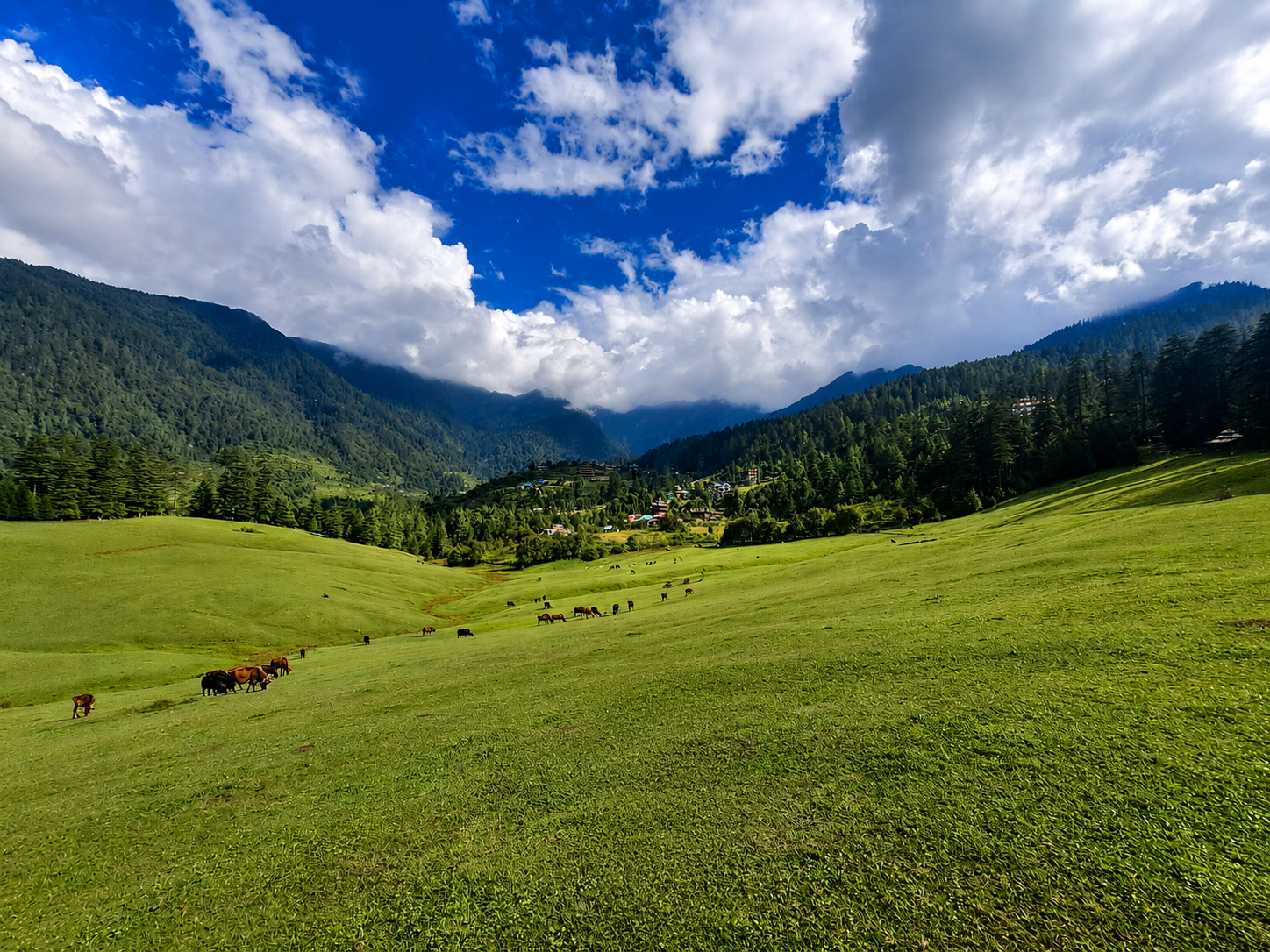
Shangarh is a detour most travellers miss entirely — about 60 km from Jibhi, three hours through the Sainj Valley. A large flat meadow at around 2,100 metres, surrounded on all sides by dense cedar and oak forest, with a 500-year-old wooden temple dedicated to Shangchul Mahadev at its edge. The Sainj Valley below it belongs to the Great Himalayan National Park buffer zone. Most people drive past the Sainj Valley turnoff on their way to Kasol or Manali. That is their loss.
Quick Facts
Distance from Jibhi
~60 km
Drive time
~3 hours
Altitude
~2,100m (6,900 ft)
District
Kullu, Himachal Pradesh
Valley
Sainj Valley
River
Sainj River (Beas tributary)
Best season
Apr–Jun · Sep–Nov
GHNP Entry Permit
₹100/day (Indians) · ₹500/day (foreigners)
Last ATM
Sainj Village — HDFC branch
Network
Airtel best; cash mandatory beyond Sainj
How to Get There
Route: Jibhi to Shangarh
The Sainj Valley road narrows significantly above Sainj village. Avoid driving after 4 PM — the final stretch to Shangarh can be tricky in fading light, especially if you are unfamiliar with single-lane hill roads. Withdraw cash at the HDFC ATM in Sainj village before going further — there are no more ATMs beyond this point.
Jibhi → Banjar
7 km, ~20 min — follow the Banjar Valley road northwest
Banjar → Larji
~22 km, ~45 min — descend through the valley to Larji, where the Sainj River meets the Beas
Larji → Sainj Village
14 km, ~25 min — take the right branch at Larji into the Sainj Valley; withdraw cash at the HDFC ATM here before continuing
Sainj → Shangarh
20 km, ~50 min — the road climbs steadily through the valley; narrows significantly in the upper stretch; park near the meadow entry and walk in
What to Do
What to See at Shangarh
Shangarh Meadow — The Pandava Threshing Floor
The meadow's local name translates roughly to 'the flat land where the Pandavas sieved grain during their exile.' According to Sainj Valley legend, the brothers rested here on their journey through the Himalaya, and the stones at the meadow's edge bear marks from their grinding stones. The meadow itself sits at ~2,100m — a large, flat clearing of short grass ringed entirely by dense deodar and oak. In spring it turns vivid green; in October the surrounding forest goes amber and gold. Almost nothing here: no shops, no food stalls, no crowds.
Shangchul Mahadev Temple
The village deity is not Shansher Devta — the correct name is Shangchul Mahadev, a manifestation of Shiva who is understood in Sainj Valley tradition to govern the entire valley and its forest. The temple is a 500-year-old wooden pagoda in the Himachali Kath-Kuni style — interlocking cedar logs and stone without mortar, a construction method that makes the structure earthquake-resistant. The carved wooden panels on the facade are some of the finest in this part of Kullu district. Remove footwear and do not enter the inner sanctum unless invited by the pujari.
Barshangarh Waterfall
A 15-minute walk from the meadow on a marked trail leads to Barshangarh Waterfall — a milky-white cascade that drops through mossy rock and deodar canopy. In monsoon and early post-monsoon, a fine mist off the falls creates small rainbows in the afternoon light. Almost no visitors know it exists. Ask at the meadow edge for the trail.
Day Trek: Ganjau Thatch
The most accessible day trek from Shangarh — 4 to 5 hours return to the high meadow of Ganjau Thatch. The trail climbs through dense GHNP buffer-zone forest above the village. No permit required for the buffer zone. You need a GHNP permit (₹100/day for Indian nationals, ₹500 for foreigners) if you intend to cross into the core zone beyond the thatch.
Hidden Villages of the Sainj Valley
The valley beyond Shangarh holds a cluster of near-abandoned settlements rarely visited by outsiders. Raila has twin slate watchtowers from a pre-Bushahr era. Deohari sits above a lake associated with Pundrik Rishi. Lapah has a crumbling British Forest Rest House from the colonial survey era. Shanshar has a Manu Rishi pagoda temple. Neuli is the last point before the core GHNP boundary — the permit checkpoint is here.
Multi-Day GHNP Treks
For experienced trekkers, Shangarh is a base for serious routes into the Great Himalayan National Park. The Lapah–Shumga circuit takes 5–6 days and crosses 12,500 ft. The Raktisar route follows the river for 7–8 days. The Jiwa Nala traverse crosses two high passes — Kandi Galu (3,700m) and Phangchi Galu (4,700m) — in 8 days. All require registered guides and GHNP permits; arrange through the Forest Department at Sainj or Larji.
Seasons
Best Time to Visit Shangarh
Apr–Jun
Spring — green meadow
Meadow turns bright green after snow melt. Rhododendrons bloom on the lower forest trail. Warm days, cool nights at 2,100m. Best for green meadow photography and the Barshangarh Waterfall.
Jul–Aug
Monsoon — lush, usually fine
Sainj Valley receives considerably less rain than Kullu and Parvati valleys. The meadow and forest are at their most lush. Barshangarh Waterfall is at full flow with afternoon rainbows. Occasional rain — carry a layer.
Sep–Nov
Post-monsoon — golden
October is the best month: clear skies, amber cedar forest, almost no visitors. The road stays open until late November. Strongly recommended if you are visiting Jibhi in autumn — pair with a Shangarh morning and return to Jibhi for the night.
Dec–Mar
Winter — snow-dusted
Light snowfall occasionally covers the meadow. Unlike passes further north, the Shangarh road usually stays open in winter — but confirm locally after heavy snowfall. A quiet alternative if you want a snow experience without going to Manali.
FAQ
How far is Shangarh from Jibhi?
Shangarh is approximately 60 km from Jibhi by road, taking about 3 hours. The route goes via Banjar and Larji, then branches right into the Sainj Valley — 14 km from Larji to Sainj village, then 20 km up to Shangarh.
What is the altitude of Shangarh meadow?
Shangarh village and its meadow sit at approximately 2,100 metres (about 6,900 feet). This is lower than commonly cited figures of 2,500–2,600m that appear on some travel sites — the higher figures refer to the ridge above the village, not the meadow itself.
Can I do Shangarh as a day trip from Jibhi?
Yes — but factor in 3 hours each way (60 km). Drive up early, spend 2–3 hours at the meadow and temple, walk to Barshangarh Waterfall (15 minutes), and leave by 2–3 PM to be back in Jibhi well before dark. The route note about avoiding driving after 4 PM applies particularly to the Sainj–Shangarh stretch.
Is there accommodation in Shangarh?
A handful of basic homestay-style guesthouses operate in Shangarh village. There are no hotels. If you want to stay overnight, call ahead or ask in Sainj village — availability is limited and there is no booking platform for most places.
Do I need a permit to trek in Shangarh?
For casual walking and the Ganjau Thatch day trek in the buffer zone, no permit is required. If you cross into the core zone of the Great Himalayan National Park — which the longer multi-day routes do — you need a GHNP permit: ₹100/day for Indian nationals, ₹500/day for foreign nationals. Permits are issued at the Forest Department office in Sainj or Larji.
Where is the last ATM before Shangarh?
The last reliable ATM is the HDFC branch in Sainj village, roughly 10 km before Shangarh. There are no ATMs beyond Sainj in this valley. Withdraw cash here — Shangarh has no digital payment infrastructure at local dhabas or homestays.
Is Shangarh accessible in winter?
Usually yes. The road to Shangarh does not reach the altitudes where passes close in winter. Light snow covers the meadow in December–February, but the village remains reachable by vehicle in most winters. Check locally before going if there has been heavy recent snowfall.
Continue the Circuit
Start Here
Begin at Winterfell, Jibhi
Private wooden cottages in the Banjar Valley — the perfect base for a Shangarh morning and the full Himachal circuit.