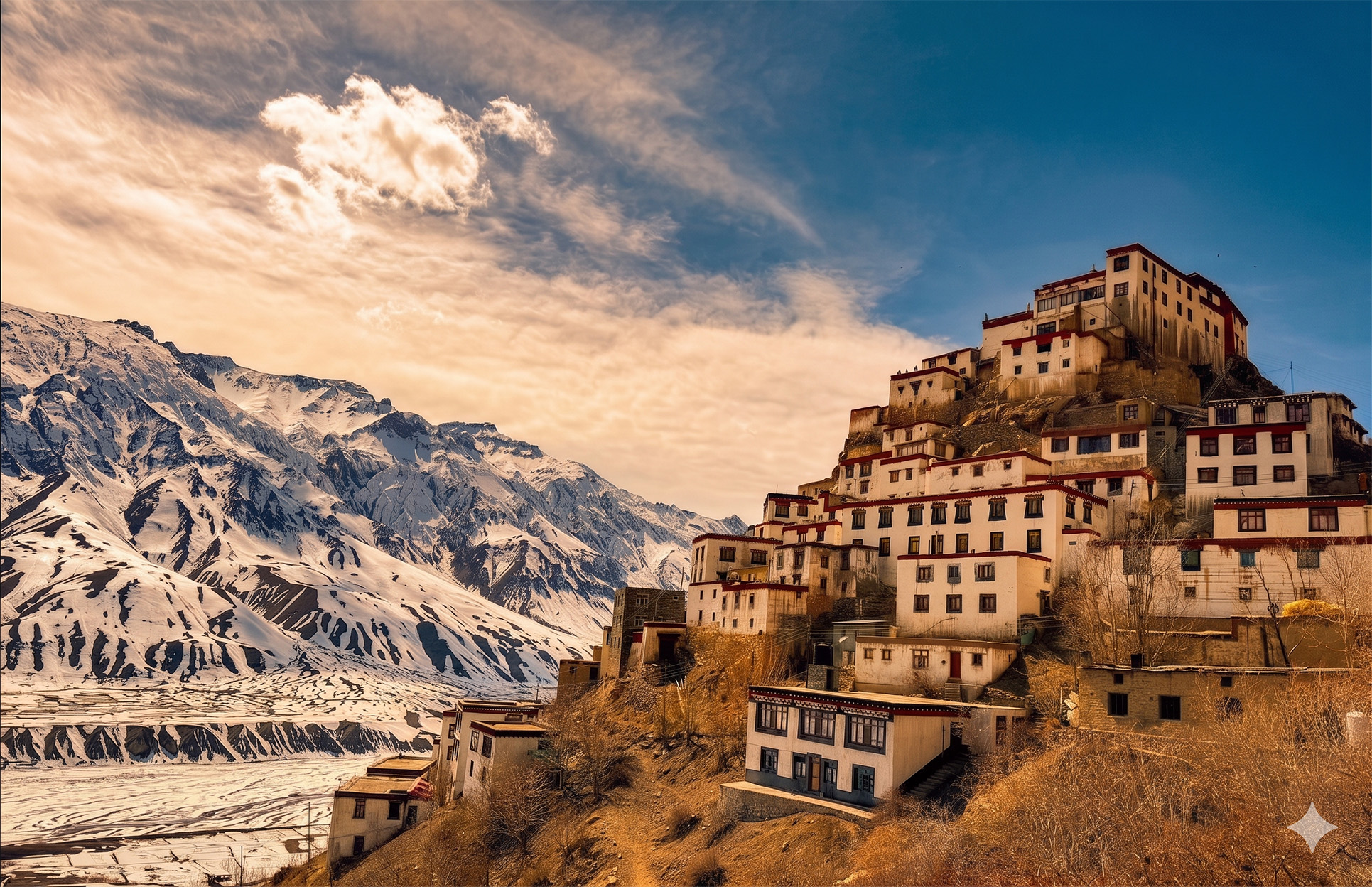
After Jibhi · Lahaul & Spiti
Jibhi to Spiti Valley
~270 km via Manali · 7–8 hours · 3,800m · Jun–Sep only
The name Spiti comes from the Tibetan Piti — meaning the Middle Land — a valley positioned between the Indian plains and the Tibetan plateau, neither fully one nor the other. Ruled by Tibet from the 11th century, annexed by the British in 1846, placed under Inner Line restrictions after 1962, and only opened to foreign visitors in 1992. What you find when you get there: 11th-century monasteries painted with 10th-century murals, high-altitude villages built from rammed earth, a darkness at night that belongs to another era. The journey from Jibhi via Manali and Rohtang takes a full day. Give yourself at least four nights once you arrive.
Seasonal road: Seasonal road: The Manali–Spiti road via Rohtang Pass is open June to September only. Rohtang vehicle permits must be booked online the day before departure — quota fills quickly in peak season. An Inner Line Permit (ILP) is also required and is free (issued at Kaza SDM office or online). Check current road and weather conditions before departure.
Quick Facts
Distance from Jibhi
~270 km via Manali
Drive time
9–10 hours (break at Manali recommended)
Altitude (Kaza)
3,800m
Altitude (Chandratal)
4,300m
Altitude (Hikkim PO)
4,440m — world's highest
Altitude (Komic)
4,587m — highest motorable village
District
Lahaul & Spiti, Himachal Pradesh
Season (Manali route)
Jun–Sep only
Season (Shimla route)
Jul–Oct only
Permit required
Inner Line Permit — free, issued at Kaza SDM or online
How to Get There
Route: Jibhi to Spiti via Manali
Break this into two days: Jibhi to Manali on day one (4–5 hrs), overnight in Manali, then Manali to Kaza on day two (6–7 hrs). The Rohtang permit must be booked the day before — quota fills fast in peak season. Watch for Pagla Nala, a stretch where glacial meltwater floods the road in the afternoon. Cross it in the morning. Near Nako, Malling Nala is a critical bottleneck prone to flash landslides — local drivers know to assess it before crossing.
Jibhi → Manali
~110 km, ~3 hours — recommended to overnight in Manali before continuing
Manali → Rohtang Pass (3,978m)
~52 km, 2–3 hours — Rohtang permit required (book online the day before); open Jun–Oct only
Rohtang → Gramphu
~10 km, 30 min — junction where road splits: left to Lahaul/Leh, straight to Spiti
Gramphu → Chhatru
~45 km, 1.5 hours — rough mountain road along the Chandra River; cross Pagla Nala in the morning before glacial melt floods it
Chhatru → Batal
~12 km, 30 min — Chandratal Lake turn-off is 15 km further on a rough track from here
Batal → Kaza
~66 km, 2 hours — the main town in Spiti; road improves significantly from here
What to Do
Highlights of Spiti Valley
Tabo Monastery — 996 AD, Ajanta of the Himalayas
Founded in AD 996 by Rinchen Zangpo — the great translator who brought Buddhism from Tibet into the western Himalaya — Tabo is one of the oldest continuously functioning Buddhist monasteries in the world. The main assembly hall contains original 10th-century murals of extraordinary quality and large stucco Buddhist deities in a state of unusual preservation. UNESCO has described its murals as among the finest examples of Indo-Tibetan Buddhist art in existence. The meditation caves carved into the hillside behind the monastery are still used by monks in winter retreat. Arrive at 6 AM for morning prayers when the space is empty and the light through the small windows is still orange.
Key Monastery — 11th Century, 4,166m
The most prominent monastery in Spiti, perched on a rocky promontory 4 km from Kaza at 4,166m. The whitewashed complex — built in the 11th century and expanded across centuries — houses around 300 monks. It is visible from miles away along the valley road. The Cham dance, a sacred masked ritual enacting the defeat of evil by protective deities, is performed here annually (typically in June–July). Early morning is the best time to visit when monks are at prayer.
Chandratal Lake (4,300m) — Crescent of Turquoise
A crescent-shaped glacial lake at 4,300m near Batal, 15 km off the Manali–Kaza road on a rough track. The water is a deep turquoise — the colour shifts through the day as light changes angle on the surrounding barren peaks. High AMS risk at this altitude for anyone who has not spent at least 2–3 nights above 3,500m. Camping is permitted at the base camp below the lake.
Langza — Tethys Sea Fossils at 4,460m
Langza sits at 4,460m above Kaza, and the fields around it contain marine fossils — ammonites, shells, and sea creatures — preserved in rock that was once the floor of the Tethys Sea before the Indian plate collided with Asia and pushed this land to its current altitude. The fossils are abundant and extraordinary but protected by law — it is illegal to remove them from the site. A large Buddha statue looks out over the valley. One of the best astrophotography locations in Spiti at night.
Hikkim Post Office — 4,440m, World's Highest
Hikkim's post office is fully operational and holds the record for the world's highest post office at 4,440m. Postcards sent from here arrive with a Hikkim postmark — they make genuine, inexpensive keepsakes. The village is 3 km from Langza on the same high ridge road. On a clear day the views from the ridge above Hikkim are unrestricted in every direction.
Komic — 4,587m, Highest Motorable Village
Komic holds the distinction of being the highest village in the world accessible by a motorable road (though this is contested with a few Ladakh villages). At 4,587m, the Tangyud Monastery here is an active site. The village has roughly 15 households. Altitude dizziness is near-certain for anyone who has not spent several days above 3,500m — do not come here on your first day in Spiti.
Dhankar Fort & Pin Valley — Buchen Lamas
Dhankar Fort, balanced on a promontory above the confluence of the Spiti and Pin rivers, was once the seat of the Nono of Spiti (local chieftain under Ladakhi rule). The adjacent monastery has a monastery school. The Pin Valley — a side valley accessible from Attargo — is home to the Buchen Lamas, lay monks of the Thang Tong Gyalpo tradition who perform the Stone Breaking Ceremony, a demonstration of tantric power involving the fracture of large rocks by hand. Pin Valley National Park within it is the best area in Spiti for snow leopard sightings (November–February, accessible via the Shimla route when the Manali road is closed).
Seasons
Best Time to Visit Spiti Valley
Jun–Jul
Rohtang just open — early season
Road opens as snow clears from Rohtang. Some patches of snow still on high passes. Cold nights at altitude (sub-zero at Chandratal, Komic). Fewer tourists than August. Good window for Chandratal camping. Cham dance at Key Monastery typically falls in June–July.
Aug
Peak season — book ahead
Most accessible weather window. Roads clear, passes open. Busiest month — Kaza guesthouses fill up, Chandratal campsite is crowded. Accommodation must be booked weeks in advance. Good for first-time visitors who want reliable road conditions.
Sep
Best month
Crowds thin after August. Skies are clearest. Golden light across the rammed-earth villages. Temperatures drop sharply at night — sub-zero above 4,000m — but days are fine. Best overall month for Spiti photography and cultural exploration.
Oct–May
Manali route closed
Rohtang closes by mid-October. Spiti is accessible from the Shimla/Kinnaur side until late October, then fully cut off until June. Snow leopard season in Pin Valley is November–February — accessible only via the Shimla route if it remains open.
FAQ
How far is Spiti from Jibhi?
Spiti is approximately 270 km from Jibhi via the Manali route (110 km Jibhi to Manali, then ~160 km Manali to Kaza). That is why most travellers break the journey with a night in Manali. The Manali–Kaza road is open only June to September.
What does 'Spiti' mean?
Spiti comes from the Tibetan word Piti, meaning the Middle Land — a valley positioned between the Indian subcontinent and the Tibetan plateau. It was under Tibetan rule from AD 1055 until the British annexed it in 1846 as part of the Treaty of Amritsar. After the 1962 Sino-Indian War, it was placed under Inner Line Permit restrictions. Foreign visitors were only permitted from 1992 onward.
Do I need a permit for Spiti Valley?
Yes. An Inner Line Permit (ILP) is required for certain parts of Spiti. The permit is free and can be obtained online or at the SDM office in Kaza. A separate Rohtang Pass vehicle permit must be booked online the day before — the daily quota fills quickly in peak season. Carry copies of both.
What is altitude sickness like going from Jibhi to Spiti?
Significant. Jibhi is at ~1,450m and Kaza is at 3,800m — a gain of 2,350m. The rough altitude benchmarks: Shimla (2,205m) — minimal impact; Kalpa (2,960m) — mild headaches possible; Kaza (3,800m) — significant oxygen reduction; Chandratal (4,300m) — high AMS risk without 3 days at altitude first; Kunzum Pass (4,551m) — dizziness is likely if you have moved rapidly. Breaking the journey in Manali helps. Once in Spiti, spend the first full day at Kaza without going higher — no Hikkim, no Komic on day one.
Can I combine Jibhi and Spiti in one trip?
Yes, but allow at least 10–12 days total. A practical circuit: Jibhi (3 nights) → Manali (1 night) → Chandratal camp (1 night) → Kaza (3 nights, day trips to Key/Kibber/Langza/Hikkim) → exit via Shimla route through Kinnaur, or return to Manali. Jibhi is a natural soft-entry first stop before the altitude.
What is the best way to get to Spiti — via Manali or Shimla?
The Manali route (via Rohtang) is faster but open only June–September and requires a Rohtang permit. The Shimla route (via Kinnaur, Nako, and Tabo) is open longer and passes through Kinnaur's apple country, but takes 2–3 days. Many travellers do Manali route in and Shimla route out — or reverse — for a complete Spiti circuit.
What are the specific rules to follow in Spiti?
Walk clockwise around all chortens (Buddhist stupas) and mani walls — always keep them on your right. Do not remove marine fossils from Langza or surrounding areas — it is illegal under the Antiquities and Art Treasures Act. Follow zero-waste protocols on all treks: pack out everything you carry in. At monasteries, remove footwear before entering the prayer hall and ask before photographing monks or rituals.
Where should I eat in Kaza, Spiti?
Sol Cafe, established in 2012, is the most established organic cafe in Kaza — known for black pea falafels and barley pancakes. Himalayan Cafe serves dependable Tibetan food. Hotel Deyzor offers European-Tibetan fusion in a warmer setting. All three are in Kaza town.
Continue the Circuit
Start Here
Begin at Winterfell, Jibhi
Private wooden cottages at 1,450m — a gentle start to the Himachal circuit before the altitude of Spiti.