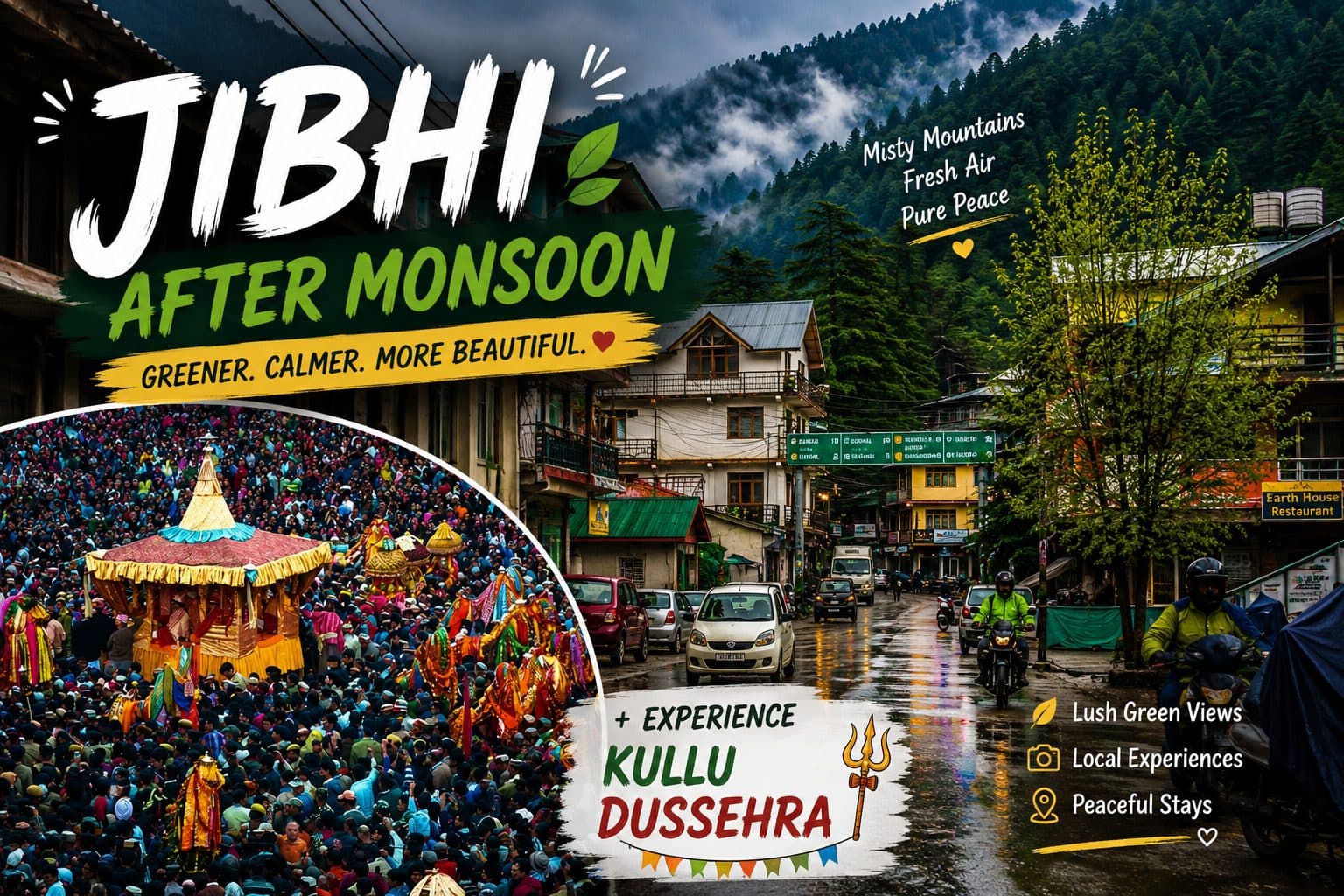
The monsoon has just left. The valley is still green. The air has cleared. And 40 km away, one of India's most extraordinary festivals is about to begin.
October is the month Jibhi earns its reputation.
The heavy monsoon rains have moved on, leaving behind a valley that's been thoroughly washed and refreshed — the forests at peak green, the trails clear, the sky the kind of sharp blue that only appears after weeks of cloud. The air has that post-rain quality at altitude that's difficult to describe and impossible to forget.
It's also the month when the Kullu Valley hosts the International Kullu Dussehra — a week-long festival that draws 4–5 lakh visitors from across India and the world, has international status since 1972, and is unlike any other Dussehra celebration in the country.
The problem most travellers don't anticipate: Kullu and Manali get completely overwhelmed during festival week. Accommodation books out months in advance, prices spike, and the towns themselves become difficult to navigate.
The solution most travellers haven't considered: stay in Jibhi — 40 km from the festival ground, quiet, green, and completely its own thing — and day-trip to Kullu for the Dussehra experience. You get the festival without the chaos. You get the valley without the crowd.
Here's how to do October in Jibhi properly.
Why October Is Jibhi's Best Month
Ask anyone who's visited Jibhi across multiple seasons and most will say the same thing: October is the one.
Post-monsoon green. The valley spent July, August, and September being thoroughly soaked. The result is a landscape in October that's more saturated and alive than any other time of year — the forests dense and dark green, the meadows at Jalori Pass lush, the streams still running strong from the monsoon recharge.
Crystal clear air and light. The haze and humidity that build through summer are completely gone. The sky is sharp. On clear days from Jalori Pass or the ridge above Tandi, you can see ranges you can't make out in any other season — snowcapped peaks catching light that the summer sky filters out.
All trails open, all passes accessible. Jalori Pass is fully open. The Serolsar Lake trail is at its best. Raghupur Fort trek is accessible with the kind of views that make you understand why people plan entire trips around this one walk. Everything that makes Jibhi a trekking destination is available in October without the peak-season May crowds.
Crowds manageable in Jibhi, even when Kullu is packed. This is the specific October advantage that locals know and most travel blogs miss. While Kullu and Manali overflow during Dussehra week, Jibhi absorbs October visitors comfortably. The valley has enough capacity for a good October crowd without losing the quality that makes it worth visiting. You can be 40 km from one of India's most attended festivals and still have a trail to yourself.
The evenings. October nights in Jibhi drop to 8–12°C. Bonfire weather. The outdoor fires that are a Winterfell evening staple become genuinely essential — and somehow better when the air is cold and the sky is clear and the valley has gone quiet after a day on the trails.
Kullu Dussehra: What It Actually Is
Most Indians know Dussehra as a one-day celebration — Ravana's effigy burns, firecrackers go off, and it's done. Kullu Dussehra is almost the opposite of this.
It begins where most Dussehras end. The festival starts on Vijayadashami — the day most of India concludes its celebrations — and runs for a full seven days. In 2025, that's October 2 to October 8.
The history goes back to the 17th century. Raja Jagat Singh of Kullu, in an act of penance, installed the idol of Lord Raghunath — an incarnation of Lord Vishnu brought from Ayodhya — on his throne, symbolically making Lord Raghunath the true ruler of the valley. The Dussehra celebration began as an act of devotion to him and has continued without interruption for over 400 years.
Over 300 deities descend on Kullu. This is the detail that makes Kullu Dussehra unlike anything else in India. Village deities from across the Kullu district — Gods and Goddesses carried on richly decorated palanquins and chariots, accompanied by devotees, musicians, and priests — travel to Dhalpur Maidan to pay obeisance to Lord Raghunath. The procession of 300+ deities arriving over the course of the festival week is a spectacle that has no parallel in Indian festival culture.
The Rath Yatra. The central event: Lord Raghunath's idol, beautifully decorated, is carried on a hand-pulled wooden chariot through the streets of Kullu to Dhalpur Maidan. The crowds that line the route, the devotional music, the chanting — it's overwhelming in the best way.
The Nati dance. Himachal Pradesh's traditional folk dance, performed by groups in traditional dress, is a constant presence throughout the week — at the maidan, at the cultural programs at Lal Chand Prarthi Kala Kendra, in the streets. It's impossible to watch without wanting to join.
International participation. Kullu Dussehra has been an officially designated international festival since 1972. Cultural troupes from multiple countries participate each year — in 2024, 16 countries sent representatives. The result is a week where Himachali folk tradition sits alongside international cultural performances in a way that feels genuinely organic rather than forced.
The closing ceremony. The festival ends with the symbolic burning of Lanka on the banks of the Beas River — a dramatic conclusion that the crowds gather for from across the valley. It's the one moment of the festival that echoes the Dussehra tradition the rest of India follows, but the scale and setting are completely different.
Jibhi as Your Dussehra Base: Why It Works
Here's the practical case for staying in Jibhi during Dussehra week rather than in Kullu or Manali.
Kullu accommodation is a problem. During festival week, Kullu and Manali accommodation fills completely — often 1–2 months in advance. What's available at short notice is either overpriced, low quality, or both. The towns themselves are genuinely difficult during peak festival days — traffic, crowds, noise. If the festival is your primary reason for visiting and you want to be in the thick of it for the full seven days, staying in Kullu makes sense. If you want to experience the festival and also have a proper mountain trip, Jibhi is a significantly better base.
The drive is manageable. Jibhi to Kullu Dussehra ground (Dhalpur Maidan) is about 40 km — roughly 1.5 to 2 hours depending on traffic, which builds during festival week. Leave early morning (by 8 AM) and you'll arrive before the crowds peak. Return by late afternoon before the evening traffic builds. A full day at Dussehra, an evening back in Jibhi. That's the rhythm that works.
You can pick your day. The festival runs seven days. From a Jibhi base, you can choose the day that makes most sense — the Rath Yatra day for the main procession, a cultural programme evening at Kala Kendra, the closing ceremony. You're not committed to being in Kullu every day. You can spend three days in Jibhi, do one day at Dussehra, come back.
Jibhi is genuinely good in October. You're not just using it as a base — you're getting one of the best months in the valley alongside the festival. Jalori Pass, Serolsar Lake, the waterfall, the cafés, the bonfires. October Jibhi earns its place independently of Dussehra.
How to Plan the Dussehra Day Trip from Jibhi
Get there early. Leave Jibhi by 7:30–8 AM. The festival ground at Dhalpur Maidan fills rapidly as the morning builds, and the best positions for watching the deity processions go quickly.
Hire a local taxi. Your Winterfell host can arrange a taxi for the day. A dedicated vehicle means you're not dependent on shared transport timing and you can leave when you want to. Expect ₹2,500–3,500 for a full day return trip to Kullu from Jibhi during festival week — book in advance, drivers fill up fast.
Which day to go
Day 1 (October 2): The opening Rath Yatra (October 2) — Lord Raghunath's chariot procession — is the most significant single moment of the festival. If you can only go one day, go on Day 1.
Mid-week days: Deity processions continue, cultural programmes at Kala Kendra in the evenings (tickets ₹500 per night), handicraft exhibitions, local food stalls. Less intense than Day 1, more comfortable to navigate.
Final day (October 8): The closing Lanka Dahan ceremony by the Beas River. Dramatic, atmospheric, worth going for if you're in the area.
What to carry: Cash (many stalls are cash-only), comfortable walking shoes, a layer for the evening if you're staying for cultural programmes, fully charged phone. The maidan is large and the crowd is significant — keep your group together and agree on a meeting point early.
Eat at the festival. Himachali food stalls, local handicrafts, street food from across the region — the market around Dhalpur Maidan during Dussehra is itself worth the trip. Try the local food, buy something from the craft stalls.
The October Jibhi Itinerary
Day 1 — Arrive, settle, waterfall walk
Get in by afternoon. The post-monsoon valley hits differently — if you've been before, you'll notice how different it looks after the rains. Walk to the Jibhi Waterfall in the late afternoon — the trail is short, the light is golden, and the forest still holds monsoon-green. Evening bonfire at the guesthouse.
Day 2 — Jalori Pass and Serolsar Lake
The full trek day. October conditions are the best of the year for this — all trails open, clear air, wildflowers still present at altitude. Pack lunch from Banjar, hire a taxi to the pass, spend the full day. The walk from Jalori Pass to Serolsar Lake and back (10 km round trip) takes 4–5 hours at a comfortable pace. The views from the pass on the return are the cleanest of the year.
Day 3 — Dussehra day trip to Kullu
Early start — leave by 7:30–8 AM. Full day at Dhalpur Maidan. Back by early evening. Bonfire and rest. This is the day that makes the trip; come back having seen something genuinely unlike anything else in India.
Day 4 — Slow Jibhi day
Mini Thailand waterfall, Tandi village, café hopping, river walk. The recovery day that turns out to be one of the best ones. No agenda. Let the valley set the pace.
Day 5 — Raghupur Fort or Chaini Village
Raghupur Fort from Jalori Pass if you want another serious trek — the panoramic views at the top in October are the reward for the climb. Chaini village if you want culture and architecture without altitude. Both are October-perfect. Either works as a final full day before departure.
Booking October in Jibhi: What You Need to Know
October is the most sought-after month at Winterfell — and for good reason. Demand is highest, availability is tightest.
For regular October weekends: Book 1–2 months in advance. October weekends fill reliably.
For Dussehra week (October 2–8): Book earlier — especially if the festival dates fall on or near a long weekend. When a national holiday extends the Dussehra weekend, Jibhi fills faster than almost any other period in the year. Don't leave it to 2–3 weeks out and expect availability.
Frequently Asked Questions
When is Kullu Dussehra 2025?
October 2 to October 8, 2025. The festival begins on Vijayadashami and runs for seven consecutive days at Dhalpur Maidan in Kullu.
How far is Jibhi from the Kullu Dussehra festival ground?
About 40 km. The drive takes roughly 1.5 to 2 hours depending on traffic, which builds during festival week. Leave early morning to avoid the worst of it.
Is it better to stay in Kullu or Jibhi for Dussehra?
Depends on your priorities. If you want to be at the festival for multiple days and evenings, staying in Kullu makes sense — but book months in advance as it fills completely. If you want a proper mountain trip with the festival as a day trip, Jibhi is a significantly better base — quieter, more beautiful, and easier to book in October.
What is special about Kullu Dussehra compared to regular Dussehra?
Kullu Dussehra starts on the day most of India's Dussehra ends (Vijayadashami) and runs for a full seven days. Over 300 local deities are carried on decorated palanquins and chariots to Dhalpur Maidan in a procession that has no equivalent in Indian festival culture. It was declared an international festival in 1972 and draws 4–5 lakh visitors annually, with cultural troupes from multiple countries participating.
What are October temperatures like in Jibhi?
Daytime temperatures are pleasant — typically 15–22°C. Evenings and nights drop to 8–12°C. Pack warm layers for evenings and a good jacket. Bonfire weather.
Are all treks accessible in October?
Yes — October is one of the best trekking months in the region. Jalori Pass is fully open, Serolsar Lake trail is at its best, Raghupur Fort trek offers the clearest views of the year. All trails are accessible.
How early should I book for Dussehra week at Winterfell?
At least 1–2 months in advance, earlier if Dussehra dates fall near a long weekend or national holiday. October is the most in-demand month at Winterfell and fills faster than any other period.
What should I not miss at Kullu Dussehra?
The Rath Yatra on Day 1 (October 2) — Lord Raghunath's chariot procession — is the centrepiece of the entire festival and worth going specifically for. The Nati folk dance performances are a constant presence throughout the week. The closing Lanka Dahan ceremony on the final day is dramatic and atmospheric.
Is October good for photography in Jibhi?
Exceptionally good. The post-monsoon air clarity means sharp, clean light. The valley is at peak green. Golden hour from the ridge above Tandi or from Jalori Pass in October produces the kind of photographs that make other months look hazy by comparison.
Can I visit Kullu Dussehra and Jibhi in the same trip?
Yes — this is the recommended approach. Stay in Jibhi for 4–5 nights, spend one full day at Dussehra as a day trip (1.5–2 hours each way), and use the remaining days for Jibhi's own October offerings. You get both experiences without the chaos of staying in Kullu during festival week.