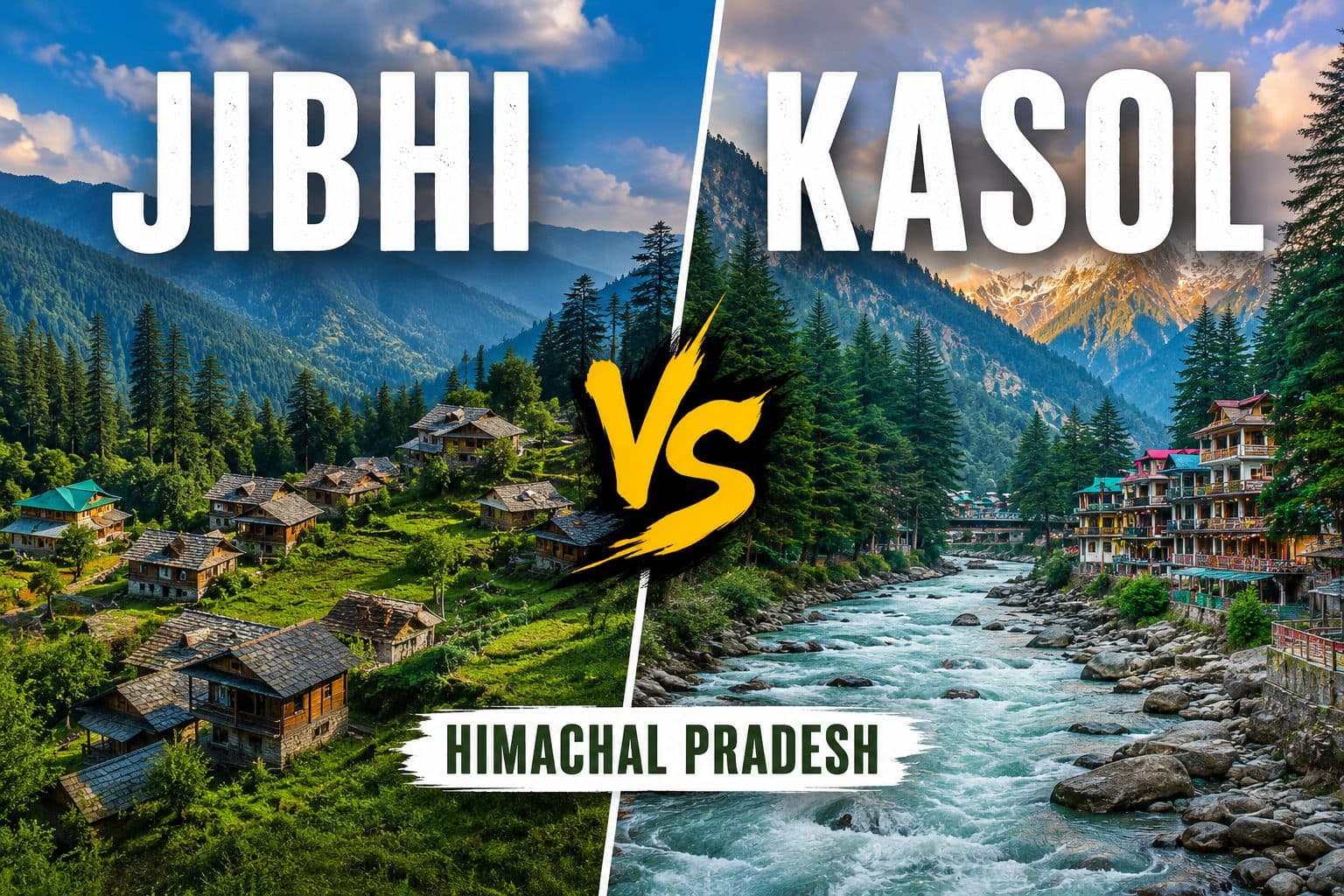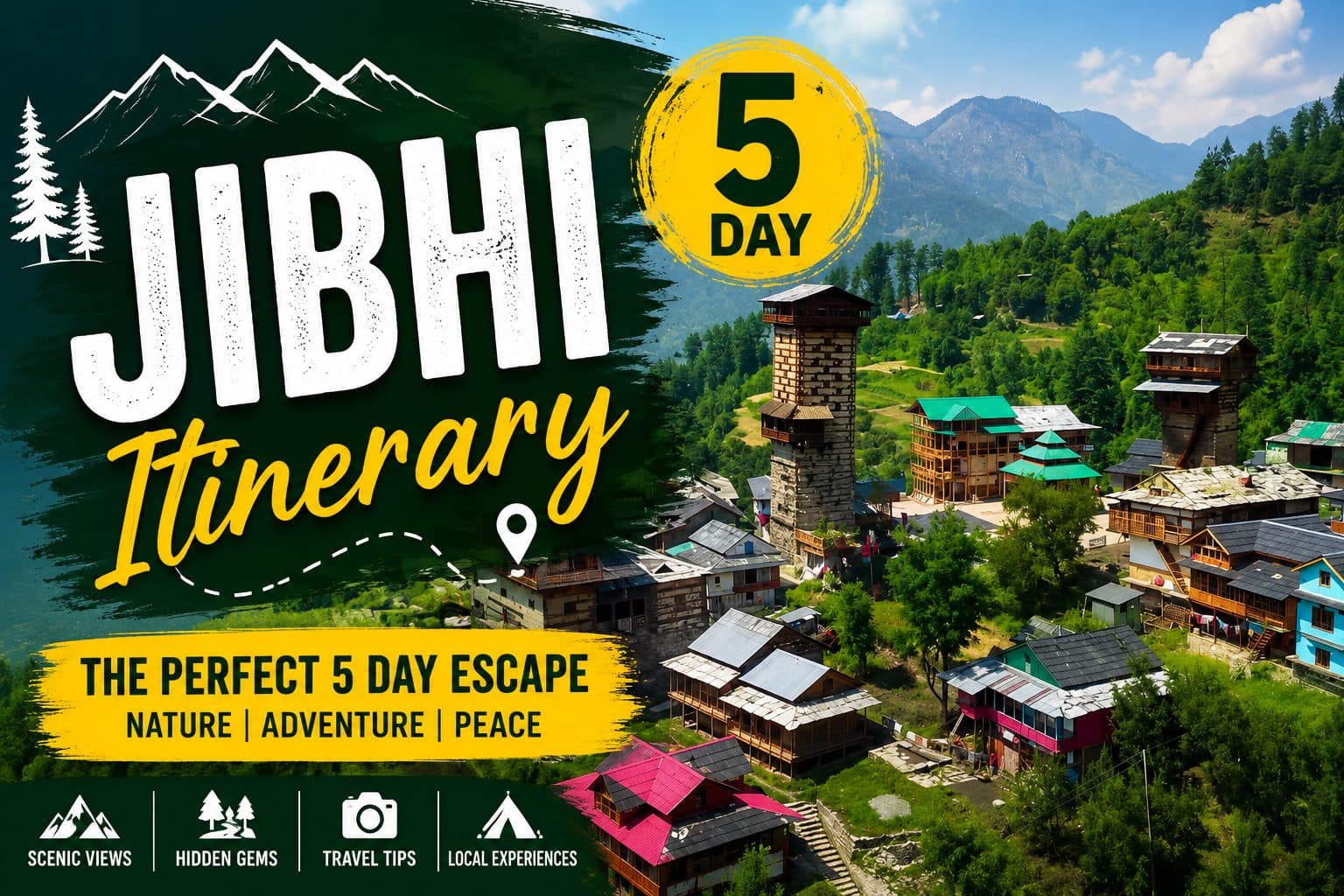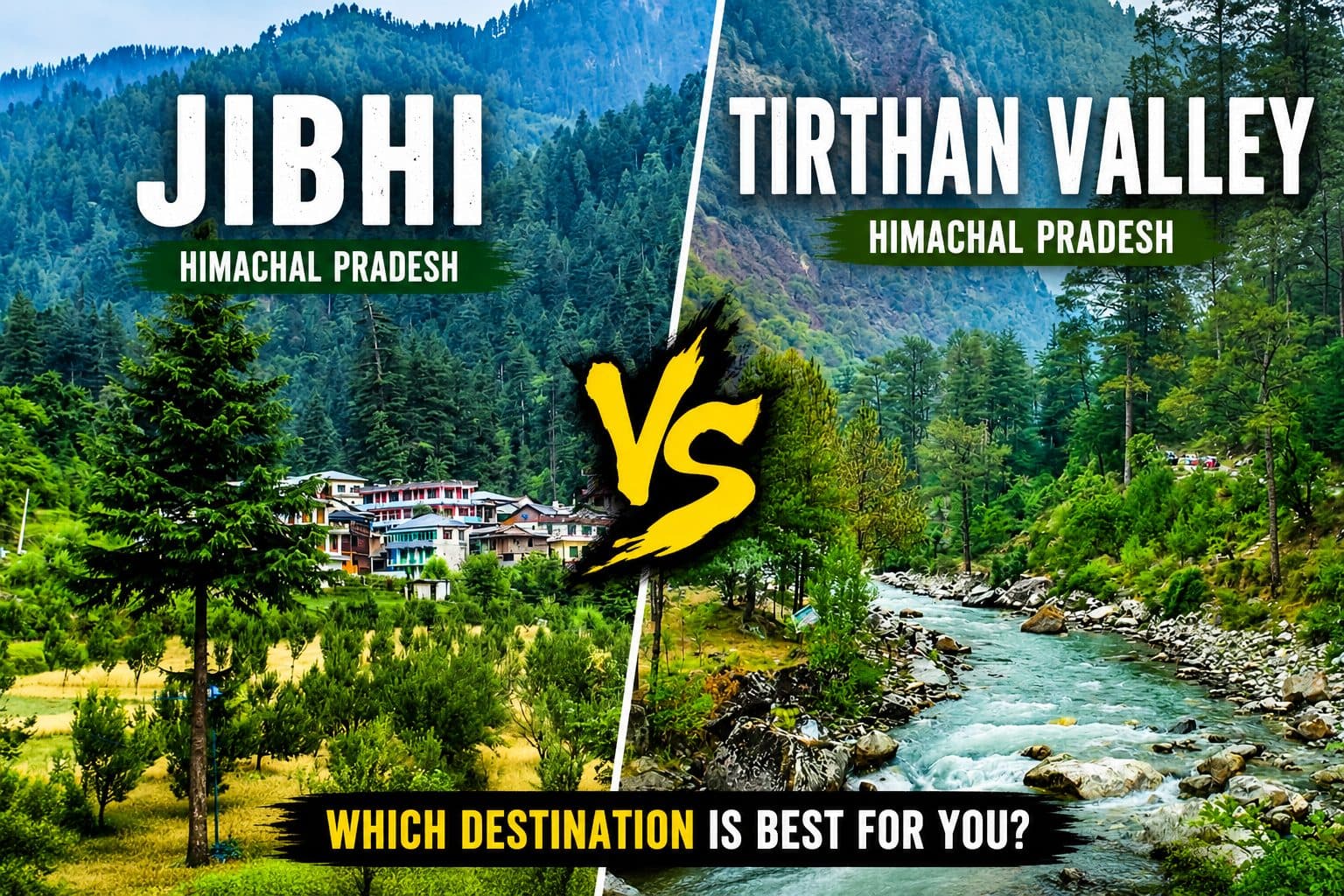
Every few days someone messages us with some version of the same thing: "We're planning to visit Jibhi and Tirthan Valley." And I always pause for a second before replying. Because what they've said is a little bit like saying "I'm planning to visit the kitchen and the house." Jibhi is inside the broader Tirthan-Banjar region. They're not two separate destinations on a checklist — they're neighbours with different rivers, different personalities, and genuinely different kinds of experiences on offer. At the same time, treating them as completely identical — which is what most travel agency marketing does — erases something important about both places. Jibhi is not Tirthan Valley. Tirthan Valley is not Jibhi. They share a district, a highway exit, a common local deity, and the town of Banjar between them. But they are built on different rivers, attract different kinds of travelers, and feel completely different once you're actually there. I live here. Let me try to explain this properly.
It Starts With the Rivers
This is the thing most travel content completely ignores, and it's the most important geographical fact about this region.
The Tirthan River
The Tirthan River is the defining force of Tirthan Valley. It originates at 4,800 metres above sea level from a glacial spring called "Tirth" at Hanskund Peak — deep inside the core zone of the Great Himalayan National Park. By the time it reaches the lower valley, it has carved a wide, expansive, open riverbed, and its water carries that distinctive bluish-green hue that comes from glacial purity and the complete absence of industrial pollution upstream. The Himachal Legislature has designated it a permanent free-flowing river — meaning the development that has consumed so many other mountain rivers simply cannot happen here.
Jibhi's River: The Pushpabhad Stream
Jibhi sits on an entirely different watercourse. The Pushpabhadra stream — powerful, rocky, fast-moving — cascades down from the heights of Jalori Pass and runs through Jibhi on its way to meet the Tirthan at Banjar. Jibhi is not in the Tirthan Valley. Technically and geographically, it's in the Banjar Valley. The turquoise rock pools everyone calls "Mini Thailand"? Is the Pushpabhadra, cutting through boulder formations unique to this valley's geology.
Two different rivers. Two different valleys. Two different topographies. Two fundamentally different experiences.
What Banjar Has to Do With All of This
If Jibhi and Tirthan Valley are siblings, Banjar is the parent. The town sits at the exact geographical point where the Pushpabhad stream — having rushed down through Jibhi — merges into the broader Tirthan River. It's the one of seven tehsils of Kullu district , the last reliable ATM in the region (withdraw cash here before going further — Jibhi has unreliable ATM), and the road junction where your route determines which experience you're heading toward.
From Banjar, the road physically forks in a Y-shape: one route follows the Tirthan River toward Gushaini, Nagni, and the gates of the GHNP. The other route turns sharply upward, climbing away from the river and following the Pushpabhad stream toward Jibhi, Shoja, and eventually Jalori Pass.
That fork at Banjar is the most honest map you'll ever get of the difference between these two places.
The Personality of Jibhi
Jibhi sits at around 2,250 metres, surrounded by steep forested mountains with deep ravines. The terrain is vertical. The vibe, counterintuitively, is social.
Because Jibhi sits on the main NH305 highway leading to Jalori Pass — connecting Kullu district to Shimla — it was forced to develop commercial infrastructure faster than the dead-end Tirthan Valley ever had to. And that's shaped everything about it.
Jibhi today is cafes. It's treehouses. It's A-frame cabins with high-speed WiFi and outdoor workspaces. It's Instagram-friendly wooden balconies over the stream. It's properties like ours at Winterfell — stone and deodar timber, bukhari in the corner, forest right outside. The traveler who comes to Jibhi is typically younger, often a couple or solo backpacker, frequently a remote worker. Activities are deliberately low-exertion: a walk to the waterfall, a drive up to Jalori Pass, long afternoons in cafes, evening bonfires.
Decompression is a legitimate and important thing to come to the Himalayas for. Jibhi does it well.
The Personality of Tirthan Valley
Tirthan Valley is something else entirely. The road goes in along the river, reaches the gates of the GHNP, and stops. There is no through-route to somewhere else. This geographic reality — a dead-end valley — means it structurally cannot become a transit corridor, and therefore structurally cannot become heavily commercialized. The geography itself has been the valley's best conservationist.
The GHNP covers 1,171 square kilometres of untouched wilderness, with the Tirthan Wildlife Sanctuary protecting a further 754 square kilometres of the broader valley catchment. To enter the core zone, you need permits — ₹100 per day for Indian nationals, ₹400 for foreign visitors. This bureaucratic friction is entirely intentional. It filters out the casual tourist. Only serious trekkers, wildlife enthusiasts, and genuine eco-tourists go all the way in.
There are no cliffside cafes here. WiFi in the deep homestays is patchy at best — BSNL is your most reliable network. The primary sound is the Tirthan River, which is loud and constant. Snow leopards and Himalayan brown bears descend toward the valley floor during heavy winter snows. The GHNP treks push above 4,000 metres.
The traveler who comes to Tirthan Valley is older, more experienced, and came specifically for the wilderness. They don't need WiFi. They need the river.
The Trout — Which Is Actually a Fascinating Story
If you want to understand Tirthan Valley's economy, you need to understand the trout. Brown Trout and Rainbow Trout are not native to the Himalayas. They were introduced during the British colonial era — a decision that, under normal circumstances, would be considered ecologically problematic. In Tirthan, something unusual happened: the trout established a stable population in the river's higher elevations, and the entire valley's tourism identity has been built around it.
The HP Fisheries Department and Forest Department regulate this resource with real seriousness. Fishing season: March 1 to October 31 only. Daily licenses: ₹100 (Forest Dept.) or ₹300 (HP Fisheries). Maximum daily catch: six fish. Minimum size: 25 centimetres. Anything smaller goes back in the river.
This isn't just conservation policy — it's the economic engine of the entire valley. Premium riverside homestays in Gushaini and Nagni market themselves almost entirely on access to prime fishing beats. Hosts act as guides, outfitters, and chefs who prepare the day's regulated catch for guests that evening. The trout turned from an invasive species into a sustainable, strictly managed asset that has kept the valley economically viable while remaining ecologically intact.
Freshwater trout, caught that morning from a glacial river, grilled with local spices and served at the edge of the forest. This is Tirthan's signature meal. And it is genuinely extraordinary.
What You Actually Do in Each Place
In Jibhi:
Walk to the Jibhi Waterfall — 15 minutes, paved path, accessible to everyone
Drive up to Jalori Pass (13 km, 45 minutes, one of the steepest road ascents in the country) and trek 4 km to Serolsar Lake — a sacred alpine lake whose surface stays perpetually clear of fallen leaves, protected by the mythos of the Ababil bird and the religious laws of Budhi Nagin
Trek 45 minutes to Chehni Kothi — a 1,500-year-old Kath-Kuni tower, 45 metres tall, built without cement or nails, that survived the 1905 Kangra earthquake while British masonry crumbled around it
Long afternoons in cafes: Tenzin Café for Tibetan thukpa, Forest Bean on the cliffside for mushroom pizza, Emberwood for the proper Himachali thali
In Tirthan Valley:
Multi-day permitted treks into the GHNP core zone — genuine wilderness, no commercial infrastructure past the gates
Regulated trout fishing on licensed beats of the Tirthan River — early morning, glacial water, silence
Birdwatching for species serious naturalists travel from abroad to see — Himalayan Monal, rare forest birds
The Chhoie Waterfall near Sarchi — a strenuous 30-minute uphill hike through dense forest
Serolsar Lake and the Indigenous Conservation That Actually Works
Serolsar Lake sits at the top of Jalori Pass, accessed via a 5-kilometre trek from the summit. Despite being completely enclosed by shedding broadleaf and coniferous forest — trees that drop leaves constantly — the lake's surface is perpetually clear. Not one fallen leaf floats on it.
The local explanation, passed down through generations, is the Ababil bird, the lake's mythological guardian. The lake is sacred to Budhi Nagin, mother of all serpent deities in the Seraj region. Entering the water is prohibited. Bathing is prohibited. Wearing shoes near the periphery is prohibited.
This set of rules — derived entirely from religious tradition and folklore, enforced by community belief rather than park rangers — functions as near-perfect environmental protection. Ancient myth doing the job of a National Park management plan. I find this genuinely remarkable every time I think about it.
What They Share: The Culture That Runs Underneath Both
For all the differences in river systems and traveler demographics, Jibhi and Tirthan Valley share something deep.
The Shringa Rishi Temple in Baggi village — about 6.5 kilometres from Banjar, 4 kilometres from Jibhi — is the spiritual centre of the entire region, not just one valley. Built in Kath-Kuni pagoda style with intricate wood carvings and cantilevered balconies projecting out over the valley, it's dedicated to the sage Rishyasringa — who performed the fire sacrifice in the Ramayana that led to Lord Rama's birth. The people of this valley consider him their ultimate protector against natural disaster and poor harvests. Both valleys share him.
The festival calendar ignores the geographical boundary between the Pushpabhad and Tirthan rivers entirely. The Faguli Festival in February the Shairi harvest festival in September, the Magh-Sakranti in January. And most significantly: the Banjar Mela in May, which brings residents from deepest Tirthan and highest Jibhi together in the district town to trade, socialise, and honour their shared deities.
The valleys are separated by geology. They are unified by theology.
Practical Things Before You Go
Getting Here
From Delhi it's roughly 500–520 kilometres. Most people take an overnight Volvo from ISBT Kashmere Gate (departing 5:30–7:30 PM, ₹1,300–1,800, arriving around 6 AM). You need to exit at Aut . From Aut: local buses to Banjar cost under 100 (1-2 hours). From Banjar: Jibhi is 8 km (30 min), Gushaini in Tirthan Valley is 5-20 km along with the tirthan river (45–60 min).
A Few Non-Negotiable Tips
Cash: Withdraw at Banjar. Jibhi has no functioning ATM. Tirthan Valley has even less. Both valleys shifted to UPI payments in recent time, but still its good to hsve cash.
Network: BSNL, Jio and Airtel have good service,but there will ne network issue in some areas deep in the valley.
Monsoon (July–August): Both valleys are extremely vulnerable to landslides. NH-305 has been severely damaged by flood events in recent years. Check live road status before travelling these months.
How to Actually Structure Your Trip
3 Days (the honest minimum)
Day 1 arrive in Jibhi, walk to the waterfall. Day 2 Jalori Pass and Serolsar Lake if open, or Chehni Kothi if not. Day 3 transit through Banjar to Gushaini for a riverside afternoon before heading back to Aut. You'll get the photographs. You won't get the feeling.
5–7 Days (what actually works)
Days 1–2 in Jibhi — Chehni Kothi and Shringa Rishi Temple on Day 1, Jalori Pass and Serolsar Lake on Day 2. Day 3 is a slow transition through Banjar into a Tirthan riverside homestay — afternoon by the river, no WiFi, adjust accordingly. Day 4 into the GHNP core zone with permits and a local guide. Day 5 morning trout fishing on a licensed beat before the long drive back to Aut.
The transition from Jibhi to Tirthan is its own experience. You go from a forested hamlet with cafes and treehouse aesthetics to the sound of a glacial river and nothing else. It takes an afternoon to recalibrate. Let it.
The Bottom Line
If someone asks whether Jibhi and Tirthan Valley are the same thing, the honest answer is: no, but they're family.
Jibhi is the socially connected, aesthetically driven, cedar-forested village on the Pushpabhad stream. It's where you come for treehouses, cafes, the Jalori Pass drive, and the particular pleasure of being comfortable in a beautiful place. It's more accessible, more developed, and more forgiving — and none of that is an insult. Jibhi is very good at what it does.
Tirthan Valley is the raw, regulated, river-defined wilderness descending from the glaciers of the Great Himalayan National Park. It's where you come when you want to be genuinely away from everything — no cafe to retreat to, just the river and the forest and the particular heaviness of real silence.
FAQs JIbhi vs Tirthan valley
Which is better — Jibhi or Tirthan Valley?
They're not really rivals — Jibhi sits inside the Tirthan Valley belt, so you're almost always visiting both at the same time. The difference is more about where you base yourself. Jibhi village is more developed, with more homestay options, cafes, and easy access to Jalori Pass. The Tirthan side — closer to Gushaini and the GHNP entry — is wilder, quieter, and better for serious trout fishing and forest treks. Think of Jibhi as the social hub and Tirthan as the deeper escape.
How far is Tirthan Valley from Delhi?
Tirthan Valley is roughly 500–520 km from Delhi by road, usually a 10 to 12 hour drive depending on your route and stops. Most people drive overnight, cross the Aut Tunnel in the morning, and arrive fresh. Chandigarh is the natural halfway point if you want to break the journey.
How far is Jibhi from Tirthan Valley?
Jibhi and Tirthan Valley are practically next door — around 10 to 15 km apart depending on which part of the Tirthan you're heading to. It's a 20 to 30 minute drive at most. Most travelers base in Jibhi and explore Tirthan as a day trip, or vice versa.
How far is Tirthan Valley from Aut?
Aut is the gateway — once you exit the Aut Tunnel and turn onto NH305, you're about 30 to 35 km from the Tirthan Valley area. That's roughly 45 minutes to an hour of driving through the Banjar Valley. Aut is also where you'll get off if you're coming by bus from Manali, Delhi, or Chandigarh.
What is the nearest railway station to Tirthan Valley?
The nearest railway station is Jogindernagar, around 60 to 70 km away, though connectivity there is limited to a narrow gauge toy train from Pathankot. Most travelers use Chandigarh or Ambala as their rail base and hire a cab from there — it's a much smoother and faster option.
What is the weather like in Tirthan Valley?
Tirthan Valley has classic Himachal hill weather. Summers from March to June are cool and pleasant, perfect for treks and river walks. Monsoon from July to September brings heavy rainfall and lush greenery but can make roads tricky. October and November are crisp and clear — arguably the best time to visit. Winter from December to February is cold, the higher reaches get snow, and Jalori Pass closes — but the valley itself stays accessible and quietly beautiful.
What is the temperature like in Tirthan Valley?
In summer, daytime temperatures hover between 15 and 25°C — warm enough to enjoy the outdoors, cool enough to sleep well without AC. Winters drop to near zero at night and stay in single digits through the day. The shoulder months of October–November and March–April are the sweet spot — mild days, cold nights, and far fewer crowds than peak season.
Can I visit both Jibhi and Tirthan Valley in one trip?
Yes — and you almost certainly will without even planning for it. They share the same valley, the same roads, and largely the same traveler base. Two to three days covers both comfortably. Base in Jibhi for the homestays and Jalori Pass access, and make at least one day trip down to the Tirthan riverside, Gushaini, and the GHNP entry point. It's one of the most rewarding combinations in all of Himachal.