The mountains don't charge an entry fee. Everything else in Jibhi is negotiable. Here's how to do it properly — for less.
Here's something most travel blogs won't tell you: Jibhi is one of those rare places where spending less actually gets you closer to the real experience.
The expensive stays are closer to the road — convenient, yes, but also noisier, more generic, more removed from the forest and the stream and the actual feel of the valley. The cheaper stays are further in, accessed by a short trail through the trees, surrounded by nothing but hills and birdsong and the occasional local walking past with a load of firewood.
Budget travel in Jibhi isn't a compromise. It's a different — and often better — way of being here.
Whether you're a college student stretching a week's savings or a working professional who wants a real break without a real dent in the account, this is how you do Jibhi properly for less.
Who Actually Shows Up in Jibhi on a Budget
A mix. College students and backpackers who've heard about it through word of mouth and Instagram reels. Young professionals who've done Manali twice and want something quieter. Solo travellers. Small friend groups splitting costs. People who planned this trip for three months and people who decided on a Tuesday.
What they have in common: they're not looking for luxury. They're looking for something real — actual mountains, actual quiet, actual Himachali food — without paying resort prices for it. Jibhi consistently delivers that.
Getting Here Without Burning Your Budget
Getting to Jibhi cheaply is an art, and the HRTC bus system is your best tool.
The Cheapest Route from Delhi
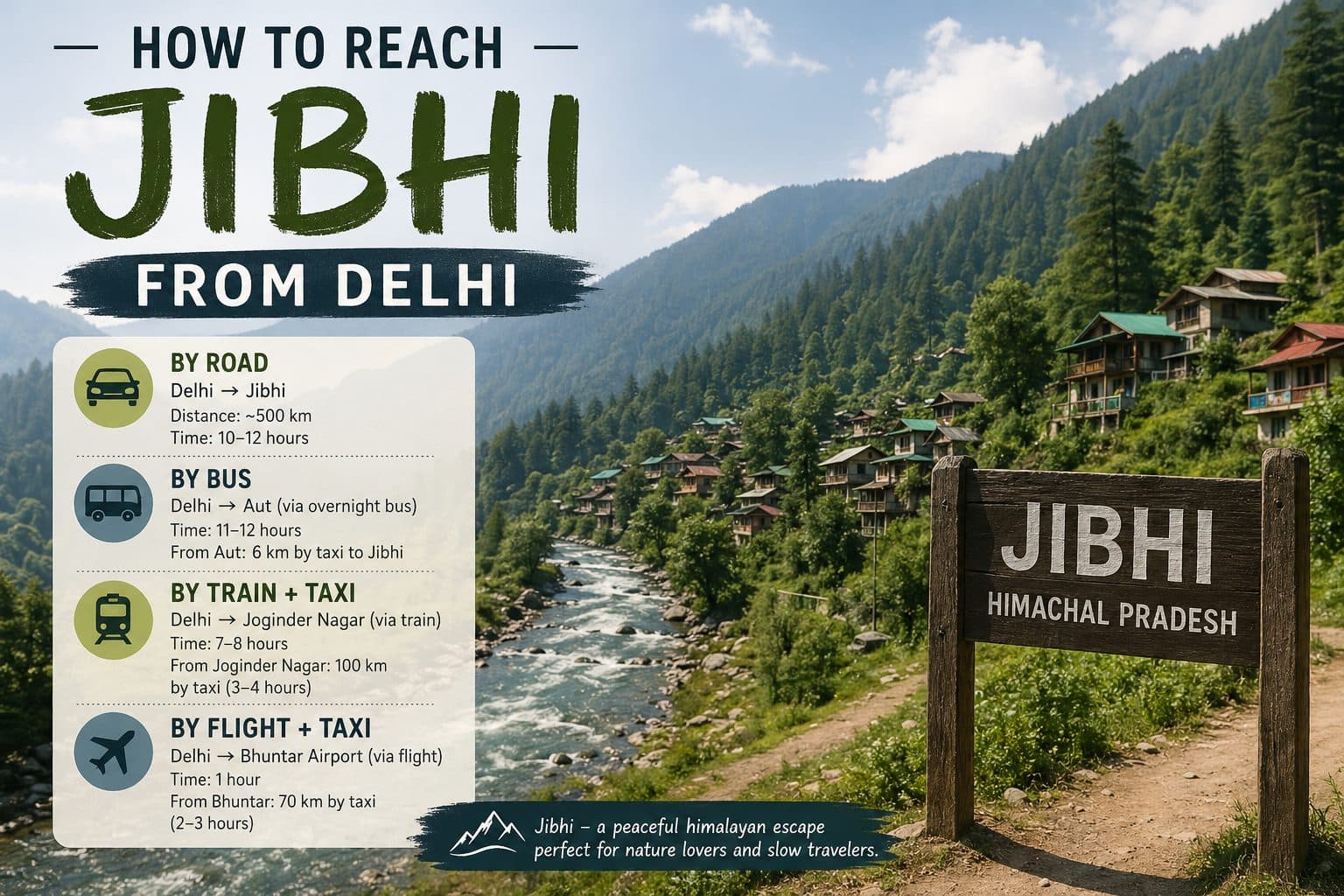
Take an overnight HRTC or Volvo bus from Kashmiri Gate ISBT towards Manali or Kullu. Get off at Aut — your ticket should cost ₹600–900 depending on the bus type.
From Aut, the cheapest combo is:
Aut → Banjar by local HRTC bus: ₹50-70
Banjar → Jibhi by local HRTC bus: ₹30–40
Direct buses from Aut to Jibhi do exist, but they're rare and timing-dependent. The trick is knowing when they run — early morning departures are your best bet. Ask at the Aut bus stand when you arrive; locals will tell you exactly what's coming and when. Don't assume — just ask.
If you miss the bus connection or arrive at an odd hour, a shared taxi from Aut to Banjar runs ₹200-300 per person. From Banjar to Jibhi, shared cab are your cheapest option — ₹50–80 per person if you're not in a rush.
A private taxi from Aut to Jibhi costs around ₹1,500–2,500. Worth it if you're in a group of three or four splitting the cost — it's actually competitive with the bus combo once you factor in waiting time.
From Manali
From Manali: About 100 km. Shared taxis run this route and cost ₹300–400 per person. A full cab is ₹3,000–4,500 and makes sense for groups.
From Chandigarh
From Chandigarh: ~265 km via the same Aut junction.
The Stay: The Local Hack Nobody Writes About
Here's the insight that will save you money and give you a better trip simultaneously.
Properties close to the main road charge more. Properties set back from the road — accessed by a short trail through the forest — charge significantly less.
Why? Less footfall, less visibility, less demand from people who don't want to walk five minutes. But those five minutes of trail walking are exactly what budget travellers should want — you arrive at a homestay surrounded by trees, with a view of the valley rather than the road, and a host who actually has time for you because they're not running a high-turnover operation.
Ask specifically for properties that are "a little off the road" when you're inquiring. The trail to reach them is part of the charm.
Smart Booking Approach — Use All of These
Book directly with the property, not through OTAs. Booking.com and Airbnb add a commission that the property then bakes into the price. Call or WhatsApp the property directly. You'll often get the same room for less, and the host will know you're coming personally.
Go on weekdays. Weekend pricing in Jibhi is noticeably higher, especially during peak months. If your schedule allows it, arrive Monday or Tuesday and leave Thursday. You'll pay less for the same room, the village will be quieter, and the cafés will actually have space.
Negotiate longer stays. Staying four or five nights? Say so upfront when you're booking. Most properties will drop the per-night rate — nothing formal, just a normal conversation. Locals run these places; they'd rather have the room filled for a week at a small discount than empty on a slow Tuesday.
Go in the right season. January to March, July to September, and November are when Jibhi is quietest — and cheapest. Same mountains, same river, same trails. Half the crowd, noticeably lower rates. Monsoon (July–September) is tricky with road conditions and occasional landslides, so build extra buffer days into your plan if you go then. January to March means cold — proper cold — but also the chance of snow, which is its own reward.
Stay Types by Budget
Dorm beds at homestays: ₹400–600/night. The best social scene, and hosts often include breakfast. This is the real budget win — you're living with a Himachali family, eating what they eat, hearing what they know.
Private rooms at family homestays: ₹800–1,200/night. Get meal inclusion if it's offered — a home-cooked Himachali dinner is cheaper and better than eating out every night.
Basic wooden cottages: ₹1,200–1,800/night. The off-road ones especially. Cosy, private, and genuinely beautiful.
Eating: Where the Real Budget Meals Are
Dhabas on the main road are your anchor. These are the places most travel blogs skip because they don't photograph well. They should be your first stop.
A proper dhaba meal in the Banjar–Jibhi stretch — rajma chawal, dal, roti, a sabzi — costs ₹80–150. It's hot, filling, cooked fresh, and tastes exactly like it should at altitude. Truck drivers and locals eat here. That's your quality indicator.
Homestay meals are the other budget staple. If your property serves food, eat there as much as possible. Breakfast and dinner included in your stay rate is genuinely the cheapest way to eat well in Jibhi. Hosts cook Himachali food — siddu, local red rice, rajma, seasonal vegetables — that you simply cannot replicate at a café for the same price.
What to Eat and Roughly What to Pay
Siddu with ghee and chutney — ₹60–100 at a dhaba or homestay. This is the dish. Steamed bread stuffed with walnut or poppy seeds. Order it every time you see it.
Rajma Chawal — ₹80–120. The Himachali version is darker, earthier, and better.
Maggi at a dhaba — ₹40–60. Fuel for trekking mornings.
Momos — ₹60–100 for a plate.
Fresh trout — ₹200–350 depending on where you eat. Splurge on this once. It's locally caught and genuinely different from anything you've had.
Thali at a local restaurant — ₹120–180. Best value for a full meal.
Café hopping is fun but adds up fast. Budget ₹150–250 per café visit if you're having coffee and food. Keep it to once a day and anchor your other meals at dhabas or your homestay.
Realistic daily food budget: ₹300–500 if you eat smart. ₹600–800 if you're café-hopping more than once a day.
What to Do: The Budget Itinerary
Free and Nearly Free
The Jibhi Waterfall — free. A 15-minute walk through a forest trail from the main area. Wooden bridges, dappled light, cold spray. No entry fee, no guide needed.
Mini Thailand — A 30 minuts walk from jibhi main market through forest trail. . The natural pool between the rocks is free to enter.
River walks — free. The Jibhi stream and Tirthan River don't charge admission. Some of the best hours in this valley are spent sitting on a rock by the water doing nothing. Budget travellers figure this out faster than anyone.
Village exploration on foot — free. Wander the lanes of Jibhi village properly. Local temples, old wooden architecture, viewpoints that aren't on any map. Ask your homestay host which direction to walk — they'll point you somewhere worth seeing.
Worth Paying For
Jalori Pass + Raghupur fort— cost of taxi to the pass (2500-3500 for a private cab, split it with your group or fellow travellers from your homestay) + zero entry fee for the trek itself. The 3k km trail to raghupur is uphill ,but manageable, and one of the most beautiful walks in Himachal. Carry your own water and snacks from Banjar — don't buy at the pass, it's marked up, and enjoy the 360 view of dhauladhar mountain range.
Bahu Village + Balo Temple — Rent a scooty for around ₹600–₹800 per day and enjoy a scenic ride through the peaceful mountain roads around Jibhi. Head towards the charming Bahu village, located about 7 km away, known for its traditional Himachali homes, apple orchards, and quiet countryside vibe. From there, continue to the serene Balo Temple, surrounded by dense forest and beautiful valley views. The route itself is part of the experience, with winding roads, fresh mountain air, and several spots where you can stop to soak in the landscape or click photos.
The HRTC Bus System: Your Secret Weapon
HRTC buses connect Aut, Banjar, Jibhi, and Shoja — and if you time them right, you can move around the entire valley for under ₹100 total.
Key things to know:
Buses run infrequently — not every hour. There are usually a few morning departures and a couple in the afternoon. Missing one means waiting a while.
Ask at your homestay or at the local bus stand the evening before you plan to travel. Locals know the timings better than any app.
The Aut → Banjar → Jibhi combo is the cheapest way in. The Banjar → Shoja route exists and is worth taking if you want to see Shoja without hiring a vehicle.
Direct Aut → Jibhi buses are rare but they do run — the morning slot is your best chance. Worth waiting for if you're not in a hurry.
You can also catch Jibhi → Aut buses while heading back and avoid the hiring cab directly to aut.
The bus ride itself is part of the experience. Windows down, mountain roads, valley views, local passengers with their shopping and their goats. Nobody rides a bus to Jibhi and regrets it.
Packing for Budget Travel in Jibhi
Things that save you money on the ground:
Reusable water bottle — fill from your homestay. Avoid buying plastic bottles daily.
Snacks from Main market — If you stay is away from main market ,stock up on biscuits, dry fruits etc. The further you go into the valley, the more things cost.
Layers, not just one warm jacket — temperature swings wildly between day and night. Layers are lighter to carry and more flexible than one heavy jacket.
Trekking shoes — rent in Jibhi only if you absolutely must. Bring your own; rental gear is expensive relative to the rest of the trip.
Powerbank — electricity can be patchy during rain. Charge everything when you have power.
Cash — carry ₹3,000–5,000. ATM in Banjar is your best bet; don't rely on finding one in Jibhi itself.
What It Actually Costs: Per-Day Budget Breakdown
Expense | Budget Option | Per Day |
Stay | Dorm bed / off-road homestay | ₹400–800 |
Food | Dhabas + homestay meals | ₹300–500 |
Transport (local) | HRTC buses + shared taxis | ₹50–150 |
Activities | Waterfall, river, village walks | ₹0–100 |
Trek day (Jalori) | Shared taxi + snacks | ₹600–1000 |
Scooty day | Full day rental | ₹600–800 |
Comfortable budget: ₹800–1,200/day (excluding travel to Jibhi) Tight budget: ₹600–800/day if you eat at dhabas, walk everywhere, and split costs
3-night trip from Delhi can absolutely be done for ₹4,000–6,000 all in if you're disciplined about the bus journey, stay off-road, and eat local.
The Honest Truth About Budget Travel Here
Jibhi is one of the few places in India where budget travel doesn't feel like a lesser version of the "real" trip. The traveller staying in a ₹500 dorm bed accessed by a forest trail, eating siddu at a dhaba, catching the morning HRTC bus to Banjar — that person is having a better Jibhi experience than someone who drove up in a cab and booked the most visible property on the main road.
The valley rewards slowness, curiosity, and a willingness to ask locals what to do next. None of that costs anything.
Go in the off-season. Stay off the road. Eat at dhabas. Take the bus.
Jibhi will give you everything.
Frequently Asked Questions
What is the cheapest way to get to Jibhi from Delhi?
Take an overnight HRTC or Volvo bus from Kashmiri Gate ISBT to Aut (₹600–900). From Aut, local HRTC buses go to Banjar (₹40–50) and then Jibhi (₹30–40). Total transport from Delhi under ₹1,000 if you time the buses right.
Q: How much does a 3-night budget trip to Jibhi cost?
A 3-night trip from Delhi can be done for ₹4,000–6,000 all in — including transport both ways, accommodation, food, and activities — if you take the bus, stay off-road, and eat at dhabas and your homestay.
Are there dorm beds or cheap stays in Jibhi?
Yes. Dorm beds at homestays start at ₹400–600/night and are the best value in the valley — hosts often include breakfast and you're living with a Himachali family. Private rooms start around ₹800–1,200/night. The best budget stays are off the main road, accessed by short forest trails.
What are the best free things to do in Jibhi?
The Jibhi Waterfall (15-minute forest walk, free entry), river walks along the Jibhi stream and Tirthan, village exploration on foot, and the Chaini village trail are all free or near-free. The Jalori Pass trek itself has no entry fee — you only pay for the taxi up, which splits easily with fellow travellers.
Is HRTC bus a reliable way to reach Jibhi?
Yes, but you need to plan around the schedule — buses run a few times in the morning and afternoon, not every hour. Ask at your homestay or the local bus stand the evening before. The Aut → Banjar → Jibhi combo is the most reliable route. Direct Aut–Jibhi buses exist but are rare; go for the morning slot.
Can you do Jibhi solo on a budget?
Jibhi is one of the best solo budget destinations in North India. Homestay culture creates instant community — by day two you'll likely be sharing taxi costs and scooty rentals with other travellers. Solo travellers tend to get more out of the valley because they're more likely to ask locals where to go next.