Your laptop doesn't care where you open it. Your brain does. Here's how to make Jibhi your most productive week of the year.
Something is quietly happening to how India's remote workers are choosing where to work.
It started with "I'll work from home." Then it became "I'll work from a café." Then "I'll work from Goa for a month." And now — increasingly — it's "I'll work from the mountains."
Jibhi is at the centre of that shift.
A small valley in Himachal Pradesh's Banjar region, Jibhi has everything the burned-out remote worker actually needs: near-zero noise pollution, air that doesn't require an AQI app to assess, a pace of life that naturally slows your nervous system down, and — crucially — enough connectivity to actually do your job.
This isn't a digital detox post. You're not here to disconnect. You're here to work well, and then step outside and have the kind of afternoon that reminds you why you work in the first place.
Here's the honest guide to making that happen.
Who's Actually Doing Workations in 2026
The workation is no longer a niche concept. India's remote-capable workforce has grown from 7% of all roles in 2021 to 19% in 2026— that's millions of people with the technical ability to work from anywhere, many of whom are only just realising they can.
The people heading to places like Jibhi for workations tend to cluster into a few types:
IT professionals and developers — the largest group nationally, with the most location flexibility. A stable internet connection and a quiet environment is all they need. Jibhi delivers both.
Designers and content creators — writers, UX designers, video editors, social media managers. People whose work requires deep focus and who find open offices and city noise genuinely destructive to their output.
Startup founders and freelancers — running their own show, no fixed office requirement, actively looking for environments that match how they want to live and work.
Hybrid workers using leave strategically — spending Monday–Friday working remotely, using weekends for treks and exploration, effectively doubling the value of a single trip.
What all of them have in common: they're tired of producing their best work in their worst environment. They want the mountains to do something for their focus that a productivity app never quite managed.
The Honest Truth About WiFi in Jibhi
Let's address this directly, because most travel blogs either oversell it ("blazing fast WiFi!") or undersell it ("connectivity is limited, manage expectations").
The real picture:
Mobile data (Jio and Airtel): 5G works in Jibhi proper, with speeds of 10–20 Mbps in good signal areas. Enough for video calls, cloud work, Slack, emails, and most collaborative tools. Jio can be patchy near the river. Airtel tends to be more consistent. Vodafone does not work here — don't rely on it.
Property WiFi: This is where it varies significantly. Some properties run on mobile hotspot setups that struggle when multiple guests are connected simultaneously. The better properties — including Winterfell — have actual JioFiber broadband running at around 30 Mbps. This is categorically more reliable for sustained work sessions: video calls, cloud syncing, and a full work day without anxiety.
The Banjar backup: If you have a truly critical deadline, a client presentation, or anything that needs rock-solid connectivity for a few hours — Banjar town is 8–10 km from Jibhi and has stronger, more consistent signal. Worth knowing.
Power cuts: Real, especially during monsoon. The grid in this part of Himachal is not Delhi-level reliable. Properties with inverter backup make the difference between a disrupted workday and a seamless one. At Winterfell, inverter backup runs for 8 hours on full use — and 2–3 days if you're running light (lights, router, laptop charging). A power cut becomes a non-event.
The honest benchmark: Jibhi WiFi is excellent for focused async work, video calls, and cloud-based workflows. It is not the right setup for large file uploads, 4K video rendering, or anything requiring sustained high-bandwidth transfer. Know your workload before you go.
What to Look For in a Workation Stay in Jibhi
Not all Jibhi properties are workation-ready. A beautiful wooden cottage with no broadband and no power backup is a holiday property, not a work-from-mountains base. Here's what actually matters:
JioFiber or BSNL broadband — not just mobile hotspot. Ask directly before booking. "Do you have WiFi?" is not the same question as "Is it broadband or hotspot-based?" The answer to the second question changes everything.
Inverter or power backup. Power cuts happen. A property with inverter backup means your laptop keeps charging, your router stays on, and your call doesn't drop mid-sentence. Non-negotiable for serious remote work.
A place to actually sit and work. Many Jibhi stays are designed purely for relaxing — low seating, no desk surface, aesthetics over ergonomics. The honest reality: most workation-suitable properties offer a balcony table and chair setup, or sofa seating indoors. It's functional and the views are genuinely good for focus — but if you're staying more than three or four days, bring a travel cushion and consider a small laptop stand. Your back will thank you.
Meals or easy food access. When you're in a work flow, you don't want to spend 40 minutes figuring out lunch. Properties that offer meals — or are close to a reliable dhaba — protect your productive hours.
Privacy. Jibhi's homestay culture is warm and communal, which is great for solo travellers and social types. For work, you want a property where you can close a door, take a call without an audience, and control your environment.
Winterfell Jibhi: Built for This Without Trying to Be
Winterfell (winterfelljibhi.com) wasn't specifically designed as a workation property. It was designed to be an exceptionally good stay — thoughtful, private, beautifully positioned in the valley. But the same qualities that make it great for couples and solo travellers make it quietly ideal for remote work.
Winterfell has two locations:
Winterfell Jibhi — Set in Jibhi village — easy access to cafés, the waterfall trail, and the valley's main stretch.
Winterfell Tandi — Higher up, more remote, with wider valley views and deeper quiet. For those who want maximum separation from distraction.
Both properties are detailed at winterfelljibhi.com/stays . The workation setup is consistent across both:
The WiFi setup: JioFiber broadband at both locations, running at around 30 Mbps. This is the real deal — not a shared mobile hotspot that degrades when multiple guests connect. Consistent enough for video calls, cloud syncing, and a full work day without anxiety.
Power backup: Inverter backup runs for 8 hours at full load — enough to outlast most Himachal power cuts. Running light (router, laptop charging, basic lighting), it extends to 2–3 days. Cuts don't become crises.
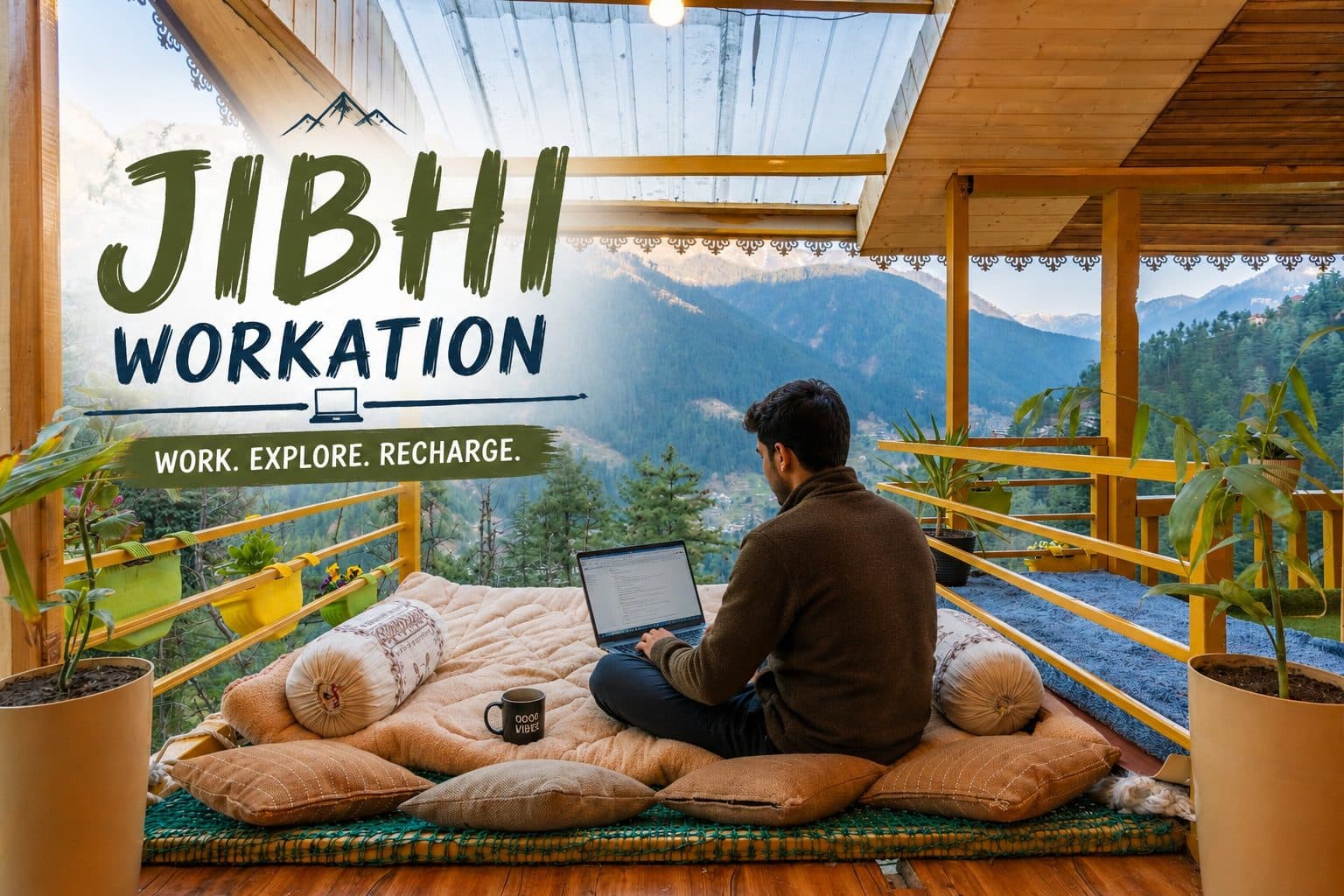
The workspace: Work from your room's balcony — mountain views, fresh Himalayan air, natural light, and the sound of the valley instead of office AC units and keyboard clatter. There's a proper table and chair setup on the balcony. Inside, it's sofa seating — comfortable for lighter sessions. There's no coworking desk or productivity theatre. Just a great view and the kind of quiet that makes deep work feel almost easy.
Privacy: Winterfell is designed around private stays, not shared hostel-style living. Even though we host many guests across different properties, each cottage and cabin offers its own peaceful, secluded space — so you can enjoy quiet mornings, uninterrupted work calls, and a more personal mountain experience without any disturbance.
Longer stays and discounts: During off-season — July to September, November, and February to March — long stays at Winterfell come with significant discounts. This is true across most Jibhi properties during these months: the valley is quiet, properties prefer a filled room for a week over sporadic short bookings. During peak season (April–June, December–January), properties fill quickly with short-stay enquiries and discounts typically aren't available. Plan your workation for the off-season and you get better rates, fewer tourists, and the same mountains.
The Workation Day in Jibhi: What It Actually Looks Like
6:30 AM: Valley fog still sitting on the hills. Step outside with chai. The kind of morning that doesn't happen in a city flat.
7:30 – 9:00 AM: First work block. Balcony, laptop, mountain view. The quiet at this hour is complete — no traffic, no construction, just birdsong and the distant sound of the stream. This is when the good work happens.
9:00 AM: Breakfast. Eat properly.
9:30 AM – 1:00 PM: Deep work block. If you have calls, morning is the window — connectivity is at its strongest, you're alert, the valley is calm.
1:00 – 2:30 PM: Lunch and a walk. The Jibhi Waterfall trail takes 30 minutes return. The river takes five minutes to reach. Walk somewhere. Come back different.
2:30 – 5:30 PM: Afternoon work block or async catch-up. Email, documentation, reviewing, creative work. The quieter hours.
5:30 PM onwards: The day is yours. Sunset from a ridge. A café with a view. The kind of evening you couldn't engineer in a city.
After dinner: Bonfire if your property arranges one. Stars above the valley with no light pollution. A conversation that isn't about work. Sleep that actually works.
Repeat for a week. Notice what happens to your output.
Working from Jibhi's Cafés: The Change-of-Scene Option
One of the underrated workation advantages of Jibhi is the café culture. There are several cafés in the village with tables, WiFi, and an atmosphere that's worlds away from a co-working space — wooden interiors, valley views, chai that arrives in proper mugs.
These are good for:
Afternoon work sessions when you want a change of scene from your property
Async work — emails, writing, reviewing, documentation
Social work — the kind where ambient noise actually helps rather than hinders
A few honest caveats: café WiFi varies and isn't always reliable enough for critical calls. For anything with a hard deadline or a client on the other end, stay at your property where the broadband is consistent. Use the cafés for the work that benefits from a different environment, not the work that punishes connectivity issues.
Practical Setup: Making Your Jibhi Workation Actually Work
Carry two SIM cards. Jio for primary data, Airtel as backup. Don't arrive with one network and hope for the best.
Powerbank — large capacity. For days when you're working from a café or outdoor spot where charging isn't easy.
Download offline first. Large files, key documents, presentations — get them local before you arrive. Don't plan a file-heavy workflow for day one.
Noise-cancelling headphones. Less for noise (Jibhi is quiet) and more for calls — wind on a balcony can create background noise that meeting participants notice.
Ergonomics matter on long stays. The balcony table and chair setup is functional and has the best view you'll ever work with — but it's not an ergonomic desk. If you're staying more than three or four days, a small travel cushion and a laptop stand will make a real difference across 8-hour work days.
Cash: Carry ₹3,000–5,000. ATM is in Banjar. Don't run out mid-week.
When to Go for Workations
October – November: Best window. Clear skies, crisp air, minimal rain disruption, moderate temperatures. Connectivity at its most reliable. Off-season pricing available.
March – June: Pleasant, passes open, full valley activity. Peak season — book early, expect regular rates.
January – March (off-peak): Cold, quiet, deeply atmospheric. Great off-season rates. Ensure your property has heating.
July – August (monsoon): Avoid for workations. Power cuts are more frequent, roads occasionally disrupted, connectivity less stable.
The Deeper Reason This Works
There's research behind what remote workers experience in natural environments — attention restoration theory basically says that being around nature replenishes the focused attention that work depletes. Cities create what's called "directed attention fatigue." Mountains, rivers, and open sky don't demand your attention the same way — they restore it.
Which is a complicated way of saying: you will probably do better work in Jibhi than you do at your desk. Not because of the view. Because of what the view does to your brain between work sessions.
Remote-capable professionals are increasingly figuring this out. The ones who do workations regularly report not just enjoying them, but producing some of their best work during them. The combination of reduced ambient stress, uninterrupted deep work windows, and genuine recovery in the evenings creates conditions that most office environments simply can't replicate.
Jibhi is not a compromise between a holiday and work. Done right, it's better than either separately.
Before You Book: The Questions to Ask Any Property
Ask these five before confirming any Jibhi stay for a workation:
Is your WiFi broadband (JioFiber/BSNL) or mobile hotspot-based?
Do you have inverter backup for power cuts?
What's the typical speed and reliability — especially during peak hours?
Is there a proper work surface in the room?
Do you offer discounts for stays of 7 nights or more, and in which months?
At Winterfell, the answers to all five are the ones you want. Reach out at winterfelljibhi.com/contact to plan your stay — direct bookings get the best rates, and longer stays in the off-season get meaningfully better pricing.
The Bottom Line
Jibhi is not a polished digital nomad hub. There's no coworking space with standing desks, no third-wave coffee with oat milk, no networking events for remote workers.
What it has is better: genuine quiet, real broadband at the right properties, a natural environment that actively restores your capacity to focus, and the kind of mornings that make you wonder why you ever thought you needed to commute.
India's remote workforce is growing fast. The people who figure out how to work well from places like Jibhi aren't just having better vacations — they're building a better working life.
The mountains are waiting. Your Slack notifications will be there when you get back.
Frequently Asked Questions
Does Jibhi have reliable WiFi for remote work?
A: It depends on the property. The better properties — including Winterfell — run on JioFiber broadband at around 30 Mbps, which is reliable for video calls, cloud work, and a full work day. Many cheaper stays use mobile hotspot setups that degrade under load. Always ask whether the WiFi is broadband or hotspot-based before booking.
What happens during a power cut in Jibhi?
Power cuts do happen, especially during monsoon. At properties with inverter backup (like Winterfell), the router stays live and laptops keep charging — 8 hours of full-load backup, or 2–3 days on light use. At properties without backup, a power cut can mean a dropped call and lost work. Always ask about inverter backup before booking a workation stay.
Is Jibhi good for video calls and Zoom meetings?
Yes, with the right setup. JioFiber broadband at properties like Winterfell handles video calls reliably. Schedule calls for the morning window (9:30 AM – 1:00 PM) when connectivity is strongest and you're most alert. Use noise-cancelling headphones on the balcony — wind can create background noise. The Banjar backup (8–10 km away) is an option for critical calls if needed.
When is the best time for a workation in Jibhi?
October–November is the sweet spot: clear skies, reliable connectivity, minimal disruption, and off-season pricing for longer stays. January–March also works well for quieter, cheaper workations — just ensure your property has heating. Avoid July–August monsoon for workations: power cuts are more frequent and roads can be disrupted.
Can I get a workation discount at Jibhi properties?
During off-season months (July–September, November, February–March) most Jibhi properties offer meaningful discounts for stays of a week or more — they'd rather have a room filled for a week than sit empty. During peak season (April–June, December–January), properties fill with short-stay bookings and discounts aren't typically available. Book directly with the property to discuss rates.
What's the difference between Winterfell Jibhi and Winterfell Tandi?
Both offer the same core workation setup — JioFiber broadband, inverter backup, and private balcony workspaces. Winterfell Jibhi is in the main village, closer to cafés and the waterfall trail. Winterfell Tandi sits higher up in Tandi village with more remote surroundings and wider valley views. See both at winterfelljibhi.com/stay and choose based on how much separation you want.